Special bridge construction report of the Hathaway Bridge Project Panama city, Florida, USA
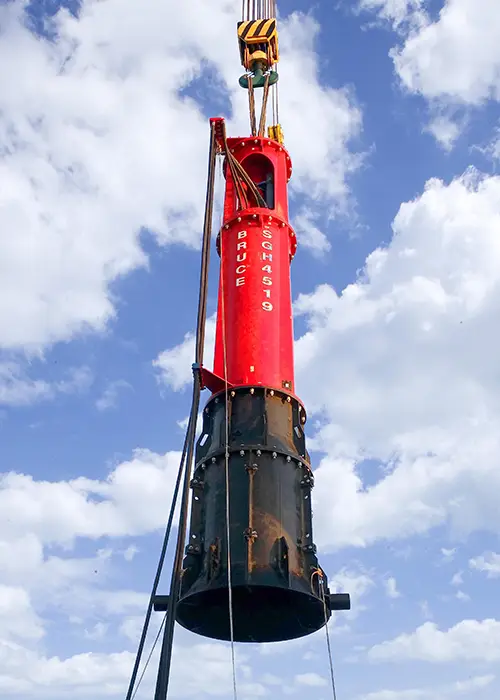
    Pile Driving 60 inch Concrete Prestressed Cylinder Pile by BRUCE SGH-3013

    A modern, elegant new span across St. Andrews Bay.

    The new Hathaway Bridge between the Bay County mainland and Panama City Beach will be postcard beautiful,
    a slender and graceful structure that is certain to become a new area landmark.
    The bridge will be functional as well, providing the traffic capacity needed for future growth and making new
    accommodations for bicycle, pedestrian and marine traffic.

    Project Overview

    1. The Need for a New Bridge

    The present day US-98 Hathaway Bridge between
    Panama City and Panama City Beach was opened to
    traffic in 1960. By 1970, an average 15,600 vehicles
    were crossing the bridge each day.
    The number doubled by 1982 and approached 57,000
    by 1998.The Hathaway Bridge has been a transportation
    bottleneck since the late 1980's, but the problem runs
    much deeper than travel delays:

    Congestion on the narrow bridge causes traffic accidents and injuries; the resulting gridlock slows transportation and
    commerce over a much larger area.

    From 1993 to 1997, a total of 416 traffic accidents occurred between the western bridge approach at Woodlawn Avenue and the eastern approach at College Drive.
    The accidents resulted in 442 injuries and a total economic loss of approximately $28 million dollars.

    The bridge provides no refuge lane for stalled vehicles, and has no sidewalk or protected lane for bicycles and pedestrians.
    The bridge's low clearance impedes marine traffic.

    Project over time the economic loss from traffic accidents and lost business - then allow for the cost of living -- and the $86 million dollars being spent to replace the bridge becomes a very logical investment.

    The new Hathaway Bridge will handle more traffic with greater efficiency, provide increased safety margins,
    contribute to the entire area transportation network, and improve the overall experience of visitors to greater
    Panama City:

    • An estimated 97,700 vehicles will use the bridge every day by 2020
    • The new bridge includes protected lanes for bicycles and pedestrians
    • A higher vertical clearance will allow for freer flow of marine traffic
    • New recreation areas will be located at both ends of the new bridge
    • Less congestion means more visitors will stop at area businesses

    The new Hathaway Bridge will be a beautiful new landmark for Bay County; it will stimulate area commerce by moving
    more traffic through the area.
    Bay County will begin to see the benefits when the first of the two new spans opens in Winter 2002 or Spring 2003.

    2. The New Bridge

    The new Hathaway Bridge is actually two bridges, which will both carry three lanes of traffic, one auxiliary lane and
    one pedestrian/bicycle lane in a single direction. The new bridges will be built just north of the existing bridge and
    within existing state right-of-way.
    No additional property will be required for the new bridges, and environmental impacts will be minimal.

    Construction of the bridges is now underway, with the northernmost span scheduled to be opened to traffic in
    Winter 2002 or Spring 2003.

    View of the old Hathaway Bridge seconds before demolition begins.

    The two 80' wide segmental bridges which will link Panama City with Panama City Beach on the gulf coast of Florida.
    This Project is being constructed by a Design Build team which includes: Granite Construction Company, HNTB,
    and Reynolds, Smith & Hills CS.

    The project which began in Oct., 2000 should be open to traffic by May of 2004.

    A side-by-side comparison

    New Bridge (Below)

    • Two separate bridges, each consisting of an 80-foot wide bridge deck
    • Four 12-foot wide lanes of traffic in each direction
    • 10-foot inside and outside shoulders
    • 8-foot lane for pedestrian/bicycle traffic on the outer edge, separated from traffic by a concrete "Jersey style"
      barrier
    • One lane in each direction to be used as a auxiliary lane, providing a "refuge lane" for disabled vehicles
    • Total Bridge Length: approximately 3800 feet
    • Vertical Navigational Clearance: 65 feet (meets minimum navigational height for the Intercoastal Waterway)

    Existing Bridge (Above)

    • A single 62-foot wide bridge deck, carrying four 13-foot wide lanes of traffic (two in each direction)
    • Three-foot outside shoulders and a four-foot wide center median with a raised curb, steel guard rails and "blinders"
    • No pedestrian access, no dedicated bicycle access
    • No "refuge lane" for disabled vehicles
    • Total Bridge Length: 3360 feet with 330-foot main span
    Vertical Navigational Clearance: 49.8 feet

    3. Project Team / Links

    The new Hathaway Bridge is being built under a construction model called Design-Build.
    Under the Design-Build method, the team of contractors that design the bridge will be the same team responsible for its
    construction.
    This differs from the more traditional model, where a design is completed first, and contractors bid to construct the project

    Design-Build is a proven system that saves time and money.
    The various independent contractors on the Hathaway Bridge project are working together as a team to deliver
    a high-quality completed project at the lowest possible price.

    Florida Department of Transportation,
    Chipley, FL

    Bay County,
    Panama City, FL

    Granite Construction, Tampa, Florida
    Design-Build Team Leader

    HNTB Corporation, Orlando, Florida
    Engineering Design Services

    CONSTRUCTION ENGINEERING & INSPECTION:

    Reynolds, Smith and Hills Construction Services,
    Jacksonville, Florida

    4. BRUCE SGH-3013 Construction Photos

    BRUCE SGH-3013 with 30 tons of ram weight
    performing a hydraulic pile driving of 60 inch diameter, hollow concrete piles that was required for the
    following specification.

    > Average weight per foot   =>  1300 lbs
    > Average length per each
     =>  115 feet
    > Quantity required
                  =>  220 each
    > Max. capacity
                        => 1550 tons

    After completion a lateral load statnamic test on top
    of the concrete piles, BRUCE SGH-3015 equipped
    by the leader guide is conducting a production pile
    driving for the bridge foundation.

    These people are pile driving crew who are responsible
    for 60¡± concrete pile driving work.

    Electrical remote control in the picture shown allows for users to have a quick Check when an unexpected
    abnormal
    functions occur.
    It is both available for checking and monitoring the
    pile driving.

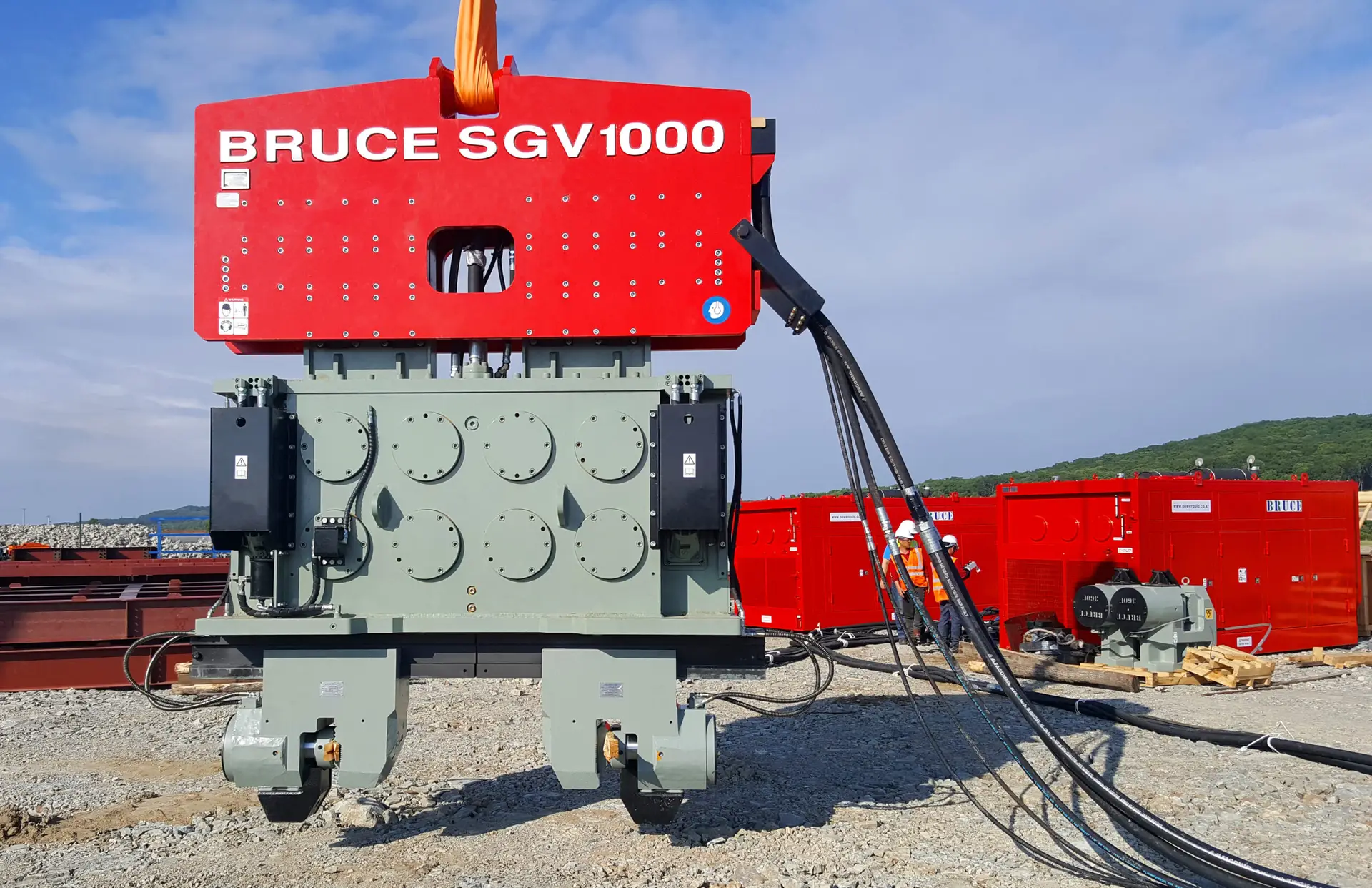
    The BRUCE¡¯s unique and customized model of PQ-600 provides powerful energy source to the SGH-3015 hydraulic
    hammer with a Cummins engine generating 600 horse power leads to have the capability of 45 ton.m (441 KJ) of
    a potential energy.

    SGH-3013 Specification

    Ram weight

    30 ton

    Max. Storke

    1.3 m

    Max. Potential Energy

    39 ton.m(390KJ)

    Power Source

    PQ-600 (600 HP)

    Release provided on Site ; www.bridgepros.com/projects/hathawayofficial/

    www.powerquip.co.kr