Hydraulic Pile Hammer vs Vibro Hammer – Which is Best for Your Soil Condition?
JH KIM
view : 32
In the piling industry, the wrong equipment choice doesn’t just cost money—it costs time, reputation, and sometimes, the entire project timeline.
Imagine this scenario: You deploy a vibratory hammer for a sheet pile project. The first 5 meters go in smoothly. But suddenly, at 8 meters deep, the pile hits a stiff clay layer or a dense sand band. Progress stops. The pile refuses to budge. You are now facing the engineer’s nightmare: “Pile Refusal.”
Your project is halted. You have to mobilize a different rig, rent a new hammer, and explain the delay to the client.
This failure usually happens not because the equipment is bad, but because the physics of the hammer did not match the mechanics of the soil.
As a global manufacturer of both Vibro Hammers and Hydraulic Pile Hammers, BRUCE (PowerQuip) provides an unbiased, engineering-based comparison. This guide will help you interpret your soil report and choose the weapon that wins the ground war.
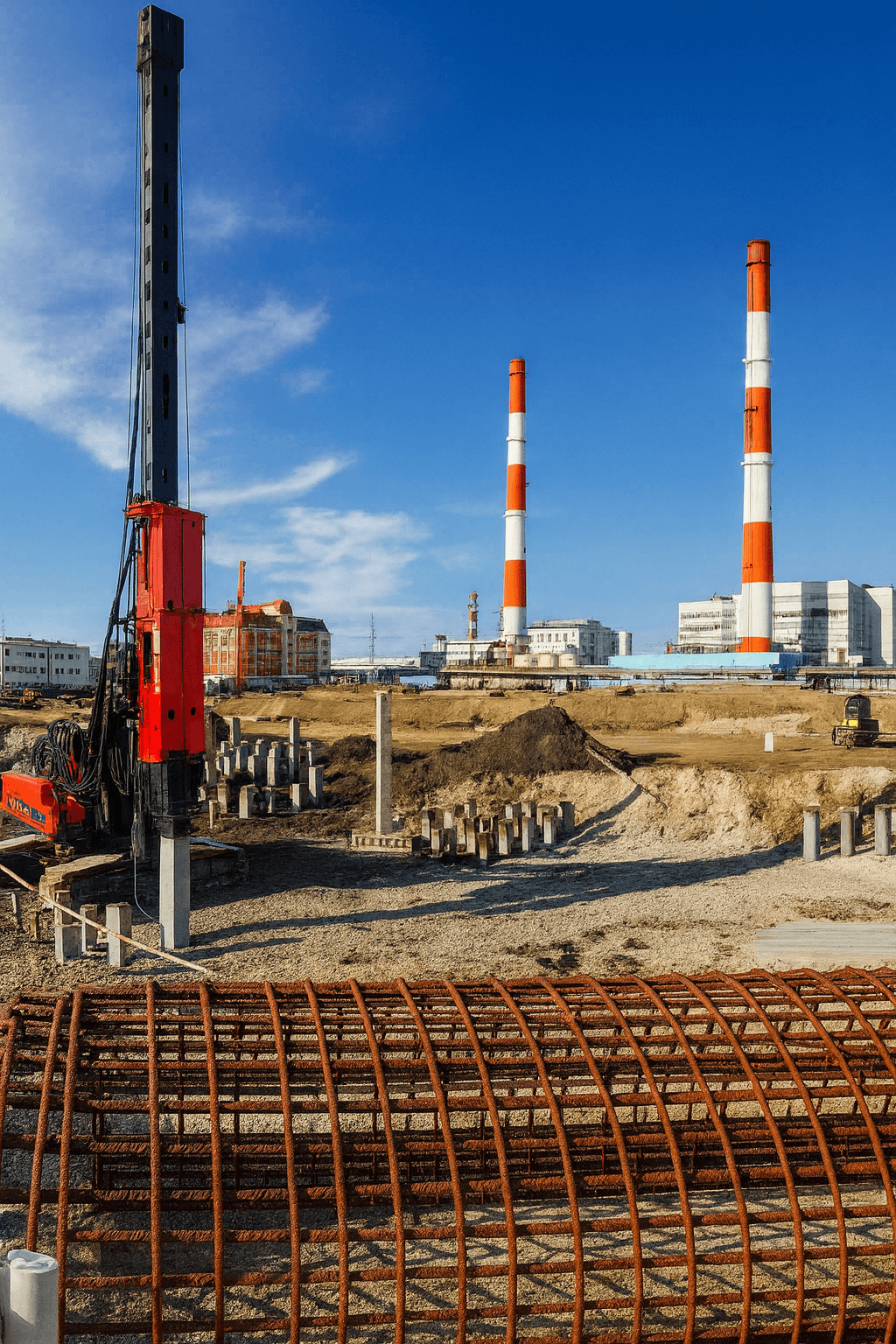
1. The Vibro Hammer: The “Speed King”
(Best for: Sand, Gravel, Soft Clay, Urban Areas)
A Vibratory Hammer (like our SGV Series) works on the principle of Liquefaction.
How It Works (The Physics)
The hammer spins eccentric weights at high speeds to create vertical vibrations. These vibrations travel down the pile and disturb the soil particles surrounding it.
-
In Granular Soil (Sand): The vibration reduces inter-particle friction, causing the soil to act like a fluid (liquefy). The pile sinks under its own weight plus the hammer’s down-force.
-
In Cohesive Soil (Clay): The vibration shears the soil structure, reducing adhesion.
When to Choose a Vibro Hammer
-
Speed is Priority: In suitable soil (N-value < 30), a vibro hammer can drive a 12m sheet pile in minutes. It is significantly faster than impact methods.
-
Urban Constraints: Modern construction sites in cities have strict noise and vibration regulations. High-Frequency Vibro Hammers minimize ground resonance, protecting nearby buildings.
-
Extraction Needs: This is crucial. A hydraulic pile hammer cannot pull a pile out. Only a Vibro Hammer can extract temporary piles (e.g., cofferdams).
💡 Technical Deep Dive:
Want to understand the detailed mechanism of how vibration drives piles?
Read our in-depth article here: 👉 Read: Vibratory Hammer Pile Driving Mechanism
🛒 Product Spotlight:
Looking for a hammer compatible with your excavator?
Check the BRUCE SGV Series specs here: 👉 View Vibro Hammer Features & Specs
2. The Hydraulic Pile Hammer: The “Power King”
(Best for: Hard Clay, Rock, Bearing Piles, Marine Projects)
A Hydraulic Pile Hammer (like our SGH Series) relies on Brute Force (Impact Energy).
How It Works (The Physics)
It functions like a giant hammer and nail. A heavy hydraulic ram is lifted and dropped (or accelerated) onto the pile head. It doesn’t rely on reducing friction; it overcomes soil resistance through massive energy transfer per blow.
When to Choose a Hydraulic Pile Hammer
-
High N-Value Soils: When the SPT N-value exceeds 50 (Hardpan, Weathered Rock), vibration dampens quickly and becomes ineffective. You need impact energy to shatter the rock or displace the stiff clay.
-
Load Bearing Verification: For foundation piles (bridge columns, high-rises), engineers need to verify the bearing capacity. A hydraulic pile hammer allows you to count the “Blows per Foot,” providing instant feedback on the pile’s capacity.
-
Marine/Offshore Projects: In deep water or inclined piling (batter piles), impact hammers provide better control and power transmission.
🛒 Product Spotlight:
Need a hammer for heavy-duty piling or offshore projects?
See the BRUCE SGH Hydraulic Pile Hammer lineup: 👉 View Hydraulic Pile Hammer Features
3. The Decision Matrix: Look at Your Soil Report (N-Value)
This is the rule of thumb we give to our global distributors. Before asking for a quote, open your Soil Investigation Report and check the SPT (Standard Penetration Test) N-Values.
| Soil Condition | SPT N-Value (Approx.) | Recommended Equipment | Engineering Reason |
| Loose Sand / Silt | 0 – 15 | Vibro Hammer | Highly efficient. Soil liquefies instantly. |
| Medium Dense Sand | 15 – 30 | Vibro Hammer | High-Frequency models recommended. |
| Stiff Clay / Dense Sand | 30 – 50 | High-Power Vibro or Hydraulic Pile Hammer | Vibro needs high Eccentric Moment here. If refusal occurs, switch to Impact. |
| Very Hard Soil / Rock | > 50 | Hydraulic Pile Hammer | Vibration will be absorbed. Only impact force can penetrate. |
(Note: This table is a general guideline. Soil behavior can vary based on moisture content and depth. Always consult with BRUCE engineers.)
4. The “Hybrid Method”: A Professional Strategy
Experienced contractors often use both technologies to maximize efficiency and minimize cost.
-
Step 1: Use a Vibro Hammer to drive the pile 80% of the depth (e.g., through the upper sand layers). This is fast, quiet, and fuel-efficient.
-
Step 2: Switch to a Hydraulic Pile Hammer for the final 20% to seat the pile into the hard bearing layer (bedrock) and verify the load capacity.
At BRUCE (PowerQuip), we design our power packs and attachments to be versatile, supporting contractors who need to switch methods on complex job sites.
5. Don’t Guess. Let Us Simulate It.
Buying the wrong equipment costs thousands of dollars in delays. Do not rely on guesswork. Let our engineering team simulate the drivability for you.
Send us an email with the following details:
-
Your Soil Report (or description of ground condition).
-
Pile Type & Depth.
-
Your Excavator Model.
We will tell you exactly which hammer—SGV (Vibro) or SGH (Hydraulic Pile Hammer)—will get the job done efficiently.
📩 Get a Free Technical Consultation:
-
Email: [email protected]
-
Official Website: www.powerquip.co.kr
-
Connect on LinkedIn: BRUCE Piling Equipment
-
See Projects on Pinterest: Piling Gallery