BRUCE pile driving guide
Hydraulic Pile Hammer: How It Works & How to Choose
A hydraulic pile hammer drives foundation piles with repeated blows from a moving ram. Hydraulic power controls the operating cycle, while the ram transfers impact energy through the driving assembly into the pile. It is also called a hydraulic impact pile hammer or hydraulic pile driving hammer.
This guide explains the mechanism, compares impact and vibratory equipment, and introduces selected BRUCE SGH hydraulic impact hammers with specifications in metric and U.S. units.
How does a hydraulic pile hammer work?
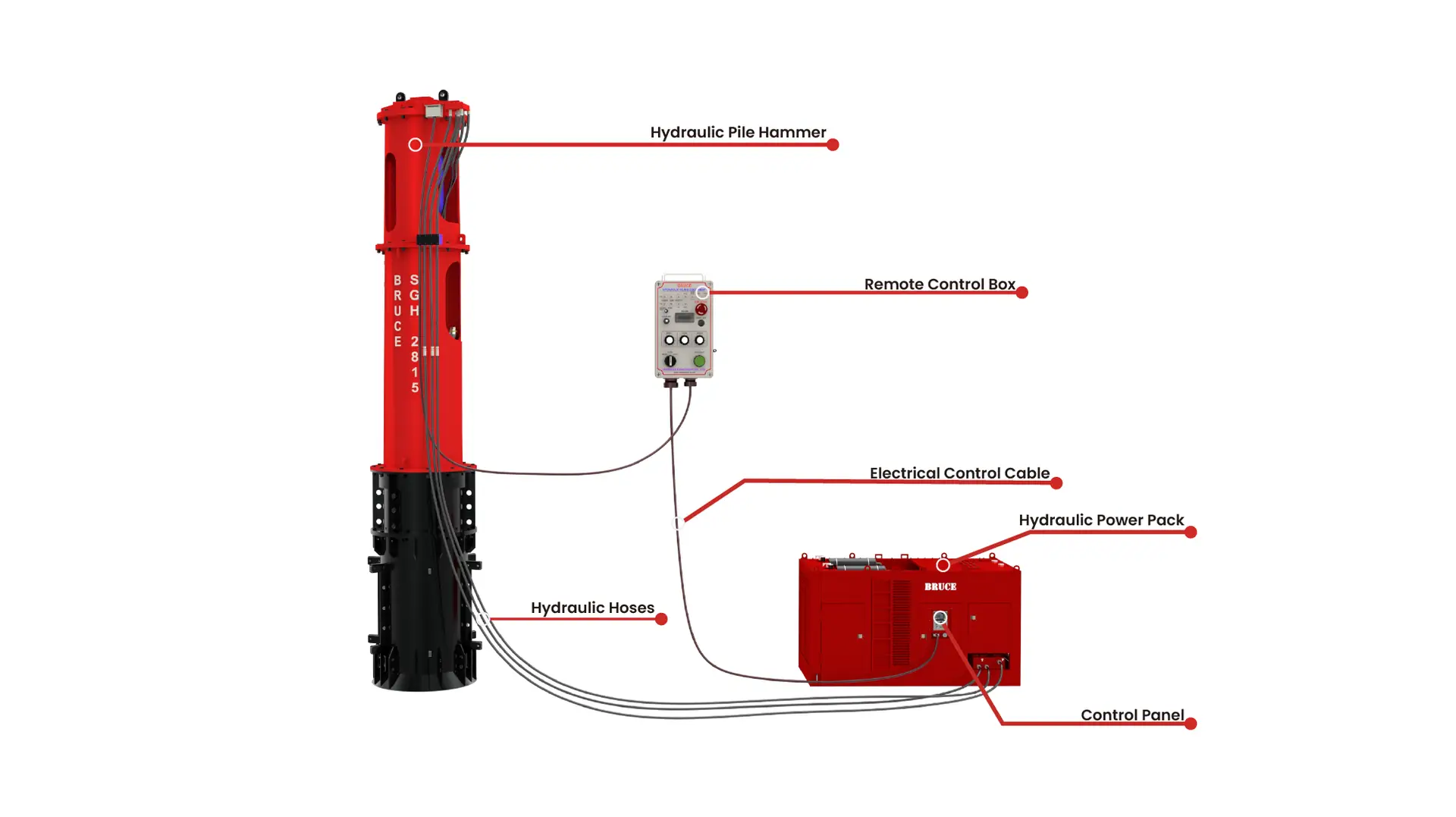
The basic cycle is lift, strike and repeat. The power pack supplies hydraulic flow and pressure, the control system regulates operation, and the driving assembly keeps the hammer aligned with the pile.
- Lift the ram. A hydraulic actuator raises the moving mass to the selected stroke.
- Deliver the blow. In a single-acting design, the ram falls under gravity and strikes the anvil. Some hydraulic hammer designs also accelerate the downstroke; their energy ratings must be interpreted using the manufacturer's data.
- Transfer energy and repeat. The anvil and drive-cap assembly transmit the blow to the pile. The cycle continues at the selected operating setting as driving resistance changes.
For a gravity-driven ram, potential energy is related to ram mass and drop height. The rated value is not a guarantee of the energy reaching the pile. The FHWA explanation of single-acting hydraulic hammers describes the lift-and-release mechanism.
What piles can it drive?
The BRUCE range supports applications involving precast concrete piles, steel pipe or casing, H-piles and sheet piles. The hammer needs a suitable drive cap, insert and mounting arrangement for the pile profile. These applications can occur on bridge, building and marine foundation projects; equipment suitability depends on the individual pile and ground conditions.
Hydraulic impact hammer vs. vibratory hammer
Both can use hydraulic power, but they move the pile differently. An impact hammer delivers separate blows. A vibratory hammer uses rotating eccentric weights to transmit repeated vibration through a clamp.
| Consideration | Hydraulic impact hammer | Vibratory hammer |
|---|---|---|
| Action | Ram blows transmitted through the driving assembly | Oscillating force transmitted through a pile clamp |
| Key ratings | Energy per blow, ram mass, stroke and blow rate | Eccentric moment, frequency, centrifugal force and amplitude |
| Typical tasks | Driving bearing piles and other piles requiring an impact installation method | Installing and extracting sheets, pipes and other compatible piles, particularly in suitable granular soils |
| Acceptance | Use the project's driving criteria and specified testing | Check whether impact finishing or separate testing is required for bearing piles |
Tables scroll horizontally on smaller screens.
Soil conditions, pile geometry and project specifications govern the choice. Read how vibro hammers work and compare with impact hammers for more detail.
Selected BRUCE SGH hydraulic pile hammer specifications
These four models illustrate different energy ratings within the SGH range. Use the table to compare published equipment data before requesting a project-specific configuration.
| Model | Maximum potential energykJ / approximate ft·lbf | Blow rateblows/min | Required oil flowL/min / U.S. gpm |
|---|---|---|---|
| SGH-0212 | 24 kJ≈ 17,700 ft·lbf | 40–60 | 100 L/min26.4 U.S. gpm |
| SGH-0512 | 59 kJ≈ 43,500 ft·lbf | 40–60 | 190 L/min50.2 U.S. gpm |
| SGH-0712 | 83 kJ≈ 61,200 ft·lbf | 40–60 | 190 L/min50.2 U.S. gpm |
| SGH-1015 | 147 kJ≈ 108,400 ft·lbf | 35–60 | 296 L/min78.2 U.S. gpm |
Source: BRUCE SGH specifications. Energy uses the published kN·m figures, equivalent to kJ. U.S. energy values are calculated from those figures and rounded to the nearest 100 ft·lbf; flow uses U.S. gallons. The original table's independently rounded unit columns may differ slightly. This is a selection of models, not the complete range.
Read the rating correctly: maximum potential energy describes the hammer, not pile bearing capacity. Required oil flow is only one compatibility check; confirm operating pressure, power pack, total suspended weight and the drive-cap arrangement for the supplied configuration.
How to choose a hydraulic pile driving hammer
1. Define the pile and installation target
Provide the pile material, section, length, wall thickness or concrete details, and intended penetration. Include the design resistance and acceptance requirements. The drive cap, inserts and cushions must suit the pile and the proposed driving system.
2. Review the ground profile and driving stresses
Use the geotechnical report and expected soil resistance with the hammer and pile data. A wave equation driveability analysis can assess likely blow counts, driving stresses and refusal risk. Neither one SPT N-value nor a universal ram-to-pile weight ratio is enough to select a hammer.
3. Match the mounting and hydraulic system
BRUCE lists fixed-leader, crane-suspended, offshore-leader and U-type arrangements. Confirm dimensions, lifting requirements, working angle, hydraulic pressure and flow. Keep ram mass separate from total hammer weight or weight with the drive cap when comparing specifications.
4. Specify the controls and site requirements
BRUCE's remote control supports start/stop, blow-rate monitoring and energy adjustment. Energy monitoring and a noise-reduction cap are listed as options. For a U.S. project, identify the required noise, vibration, engine and fluid provisions so the proposed equipment package can be checked against them.
Hammer energy is not the same as pile capacity
Rated energy is a manufacturer specification. Transferred energy is the energy actually entering the pile during a blow. Pile capacity concerns the foundation's resistance to loading. These are different quantities.
BRUCE describes its optional IEA system as recording blow energy. That function alone does not establish a pile's bearing capacity. High-strain dynamic testing uses measurements from instruments attached to the pile, with analysis to assess resistance, stresses and energy transfer. See Pile Dynamics' explanation of dynamic pile testing. Follow the project's testing and acceptance procedure.
Hydraulic pile hammer FAQs
Is a hydraulic pile hammer the same as a hydraulic breaker?
No. A pile hammer transfers blows through a driving assembly to install piles. A hydraulic breaker generally uses a tool or chisel to break rock or concrete. Specify “hydraulic impact pile hammer” when requesting foundation equipment.
Does a higher energy rating mean a better hammer for every pile?
No. The appropriate ram, stroke, driving assembly and energy setting depend on the pile and soil profile. Review penetration and driving stresses together. A higher maximum rating alone does not establish suitability or guarantee faster installation.
Does hydraulic operation eliminate noise and exhaust?
Impact driving still creates noise and vibration. Hydraulic operation avoids combustion inside the hammer, but an engine-driven power pack produces exhaust. Review the complete equipment package and site requirements; a noise-reduction option does not by itself establish compliance.
Request an SGH configuration for your U.S. project
Send the following information to help BRUCE review the hammer, drive cap and power-pack requirements:
- Project city and state, installation schedule, and required delivery location.
- Pile drawings, dimensions in inches or millimeters, length in feet or meters, and pile quantity.
- Geotechnical report, target penetration, required resistance and testing provisions.
- Available crane or piling rig, lead arrangement, and site noise or environmental constraints.
Technical reference
For background on hammer types and driving assemblies, see the Caltrans Foundation Manual, Chapter 7: Driven Piles (PDF, 2015). Use the specifications applicable to your project for current acceptance requirements.