Best Vibro Hammer for Sale – Optimizing Excavator Mounted Vibratory Hammer for Rapid Piling
Kim Moon Jung
view : 526
BRUCE equipment selection guide
Match the hammer to your excavator and pile
A vibratory hammer for an excavator is a hydraulic attachment that grips a pile and transfers vertical vibration into it for driving or extraction. Selecting the right setup means matching the hammer, excavator hydraulic circuit, mounting arrangement and pile profile.
Use this guide to compare BRUCE SGV models and prepare the information needed for a compatibility review before you buy. For the underlying mechanics, start with how a vibro hammer works.
Compare BRUCE excavator-mounted vibratory hammers
The BRUCE excavator-mounted range includes SGV-40, SGV-60 and SGV-80E models. The product overview identifies excavators in the 20–50 metric-ton range, approximately 44,000–110,000 lb, as the overall carrier range. Each hammer and mounting configuration still needs to be matched to the individual excavator.
| Model | Eccentric momentkg·m | Centrifugal forcekN / kip | Max. frequencyvpm | Max. oil flowL/min / US gpm |
|---|---|---|---|---|
| SGV-40 | 6.6 | 800 / 179.8 | 3,300 | 235 / 62.1 |
| SGV-60 | 7.6 | 910 / 204.6 | 3,300 | 290 / 76.6 |
| SGV-80E | 13.0 | 1,380 / 310.2 | 3,100 | 350 / 92.5 |
On a phone, swipe the table sideways. U.S. values are approximate conversions of the published metric figures; 1 kip = 1,000 lbf. Source: BRUCE excavator-mounted hammer specifications.
Use maximum ratings for comparison, not as operating settings. Confirm the required working flow, pressure and supplied configuration with BRUCE. A higher force rating alone does not establish suitability for a particular pile or excavator.
How to check excavator compatibility
1. Verify hydraulic flow, pressure and the return circuit
Provide the excavator make, model and hydraulic circuit data. Confirm the flow available to the attachment at the required working pressure, together with the return-line arrangement, allowable back pressure, cooling capacity and any drain-line requirements for the selected hammer.
Engine horsepower and excavator weight do not replace hydraulic circuit data. Ask for the connection and control requirements for the exact model, including rotation or tilting functions where specified.
2. Check the complete attachment weight and working reach
Review the excavator manufacturer's attachment limits and load chart for the intended boom, stick and working radius. The assessment needs to include the hammer, bracket, clamp and the load being handled. A longer arm or a different mounting bracket changes the setup and needs its own review.
Also confirm pin or coupler dimensions, hose routing and clearance through the intended movement. A nominal excavator tonnage match is a starting point, not confirmation that an attachment fits.
3. Match the clamp to the pile profile
Supply the sheet-pile section, H-pile dimensions, or pipe and casing diameter and wall thickness. Include pile length and weight. BRUCE's excavator hammer brochure describes sheet-pile, H-beam and alternative pipe or casing clamp arrangements. Confirm the exact jaws, grip range and clamp assembly for your pile.
4. Review ground conditions and project acceptance criteria
Provide the geotechnical report, planned penetration depth and any known dense layers or obstructions. Vibratory driving is often effective in granular soils, but the ground profile and pile characteristics affect performance. Reaching depth does not, by itself, verify the required bearing capacity.
The Caltrans Foundation Manual, Chapter 7, section 7-4.6 (PDF) explains the general driver/extractor principles and the need to review project requirements. The project's engineer determines the permitted installation and acceptance methods, including any impact finishing or testing.
Mounting, rotation, tilting and clamp options
Specify how piles will be picked up, positioned and installed. BRUCE documents hydraulic rotation through 360° for its excavator-mounted range, while the SGV-40T and SGV-60T are hydraulic tilting variants. The brochure describes a 90° tilting option. Confirm the functions included in the proposed configuration.
- Rotation: changes the orientation of the hammer and pile for positioning.
- Tilting: changes the pickup angle; it is a separate function from rotation.
- Clamp selection: matches the gripping arrangement to the pile profile.
- Extension arm: changes the working geometry and must be checked with the carrier and attachment configuration.
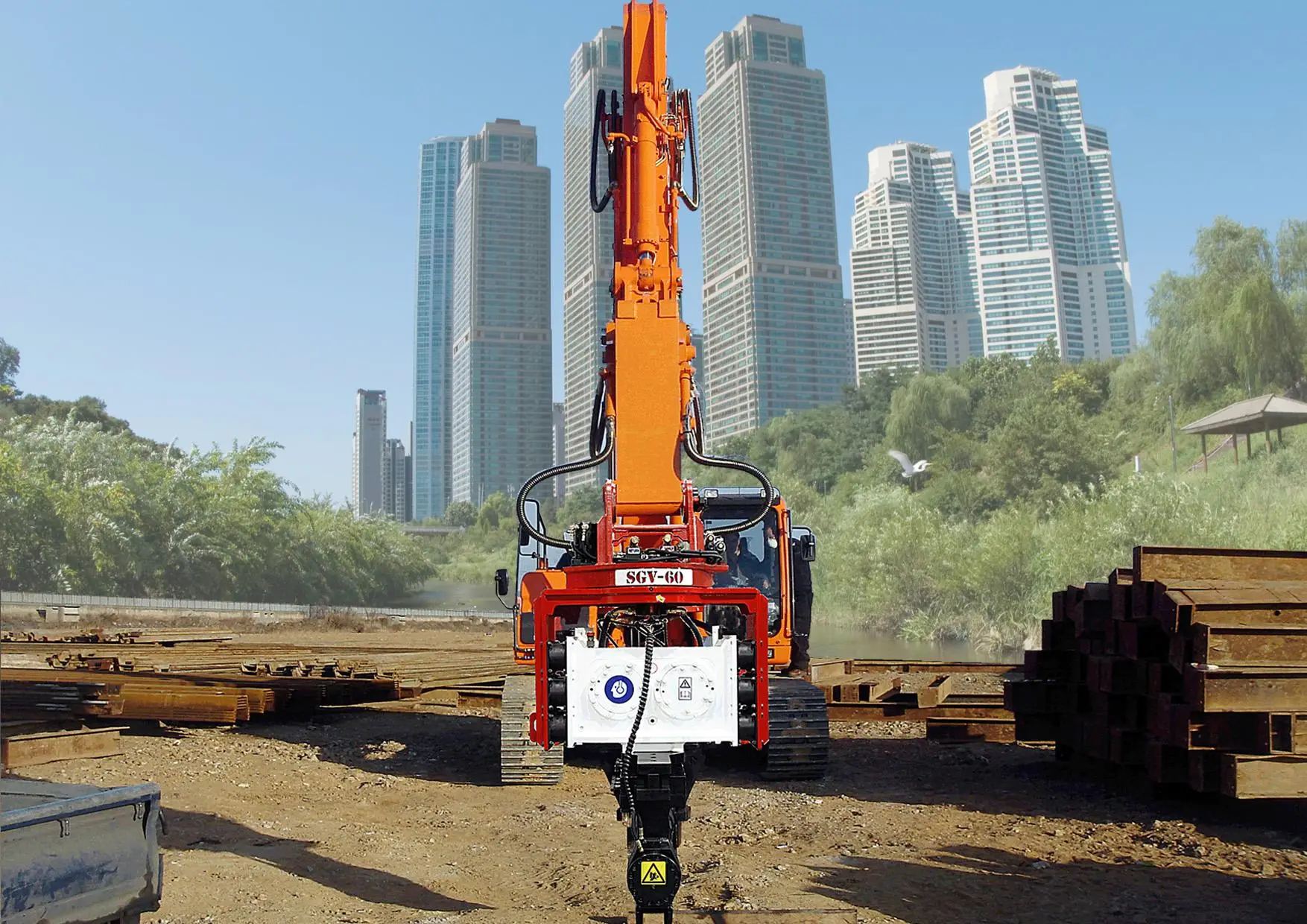
Vibration isolation at the mounting assembly reduces vibration transmitted to the carrier. It does not establish the effect on neighboring structures. Include nearby buildings, utilities and site vibration restrictions in the project review.
Frequently asked questions
Can I use an excavator-mounted vibro hammer on a mini excavator?
The published BRUCE range discussed here covers 20–50 metric-ton excavators. Compatibility with a smaller carrier should not be assumed. Share the exact excavator model, hydraulic data and intended pile so a suitable attachment can be assessed.
Does the hammer need a separate hydraulic power pack?
An approved excavator-mounted setup can use the excavator's hydraulic supply. BRUCE also documents optional power-pack configurations. Confirm the hydraulic source, controls, hoses and cooling requirements for the proposed setup before ordering.
Can one clamp handle sheet piles, H-piles and pipe piles?
Do not assume every pile profile uses the same clamp. Sheet-pile and H-beam arrangements, pipe clamps and double-clamp configurations have different geometry and limits. Send the actual pile section or drawing with the inquiry.
What affects the price of a vibro hammer for sale?
A useful quotation identifies the hammer model, mounting bracket, clamp, hydraulic connection kit and requested options. Ask for a clear breakdown of included equipment, freight, commissioning support and spare parts so quotations can be compared on the same basis.
Is an excavator-mounted hammer suitable for every pile-driving job?
Suitability depends on the working reach, carrier capacity, pile and ground conditions. Some projects require a different mounting system or an impact hammer for part of the installation. For the broader distinction, read the vibratory versus impact hammer comparison.
Request an excavator-matched quotation for your U.S. project
Send the following information so the proposed hammer, mounting and clamp can be reviewed together:
- Excavator: manufacturer, model, operating weight, boom/stick configuration and existing coupler or pin dimensions.
- Hydraulics: available attachment flow in US gpm or L/min, working pressure in psi or bar, and circuit documentation.
- Piles: section or drawing, length in ft or m, weight in lb or kg, and whether the work involves driving, extraction or both.
- Site: geotechnical information, target depth, access and working-height limits, plus nearby sensitive structures.
- Configuration: rotation, tilting, clamp, mounting and hydraulic connection requirements.
- Delivery and support: U.S. destination or ZIP code, required date, and requested commissioning, training and spare-parts scope.
Ask the quotation to state availability, delivery terms and the support arrangements applicable to your location.