BRUCE Technical Team
Driven Piles vs Bored Piles
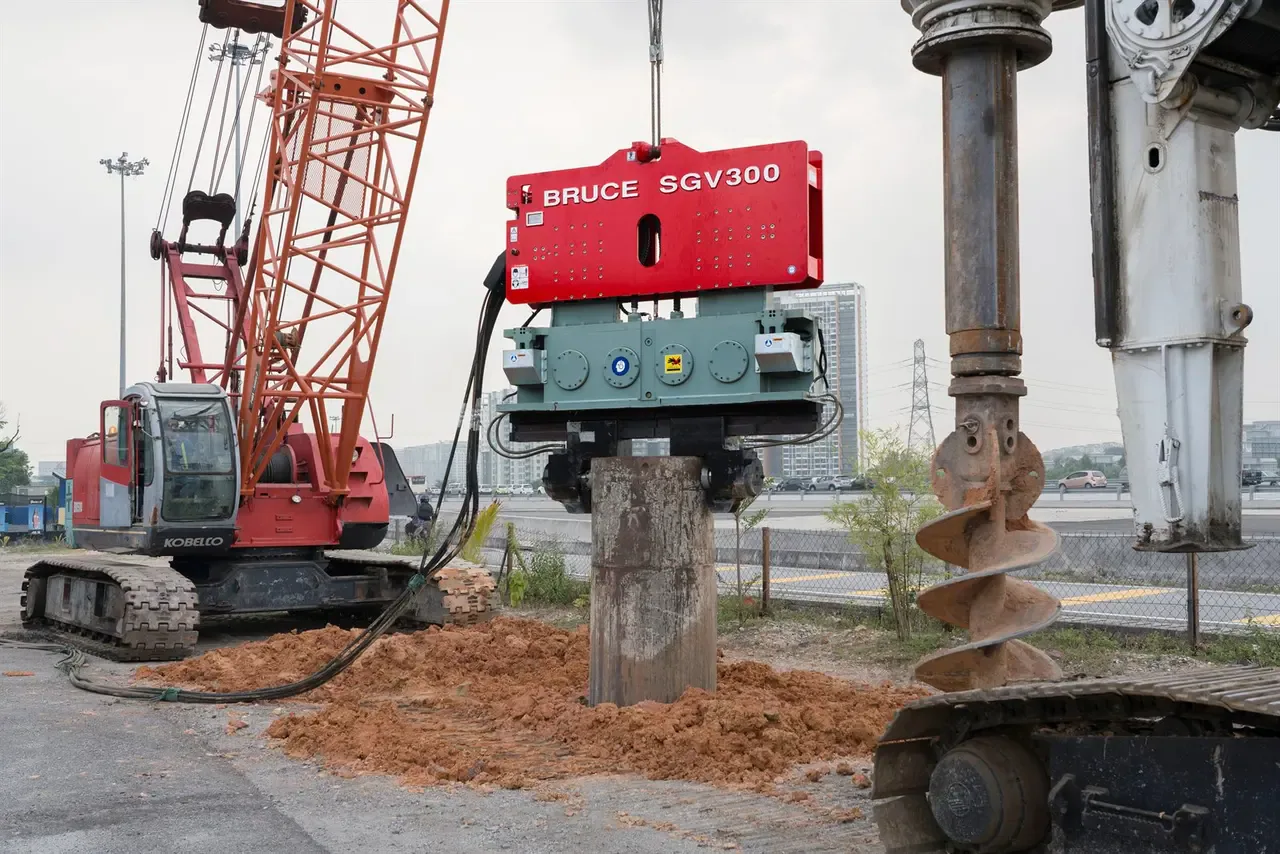
Foundation Work Basics
Driven Piles vs Bored Piles
Crews drive preformed piles with impact or vibratory equipment. They construct conventional bored piles by excavating a shaft, placing reinforcement, and pouring concrete. Engineers compare the methods against ground conditions, design loads, site restrictions, inspection requirements, and total foundation cost.
Driving checksDepth, resistance, hammer settings, pile condition, and specified testingBored pile checksBore support, base cleanliness, reinforcement, concrete, and inspectionSelection factorsGround conditions, loads, site restrictions, schedule, and total cost
Technical guide
Direct answer
Driven Piles vs Bored Piles: engineering brief
- Crews drive preformed piles by impact or vibration. Conventional bored piles require excavation, bore support where needed, reinforcement, and concrete placement. Press-in, jacking, and CFA systems use separate installation sequences.
- Compare ground conditions, design loads, noise and vibration limits, access, inspection requirements, schedule, and total foundation cost. Neither method offers a general speed, cost, or capacity advantage across sites.
- Driving set alone does not prove load capacity. For bored piles, crews must control bore stability, groundwater, base cleanliness, and concrete placement; integrity tests assess defects or continuity, not geotechnical capacity.
Article information
Technical review policy. BRUCE Technical Team prepared this reference from the listed sources. The project’s design team remains responsible for foundation design, construction specifications, and acceptance.
Planning overview
Compare site conditions and construction controls before choosing a method. Engineers assess the ground conditions and design loads. The construction team plans access, equipment, noise and vibration control, inspection, and testing.
Driven methodCrews install preformed piles by impact or vibration and record driving response. Soil displacement varies with pile shape and whether an open-ended pile plugs.
Conventional bored methodCrews excavate and support a shaft, clean the base, lower reinforcement, and place concrete under the specified controls.
Selection basisCompare the complete foundation system, including pile quantity, pile caps, mobilization, site restrictions, inspection, testing, and schedule.
The foundation engineer must confirm the system against project loads, geotechnical data, settlement limits, construction controls, testing requirements, and applicable codes.
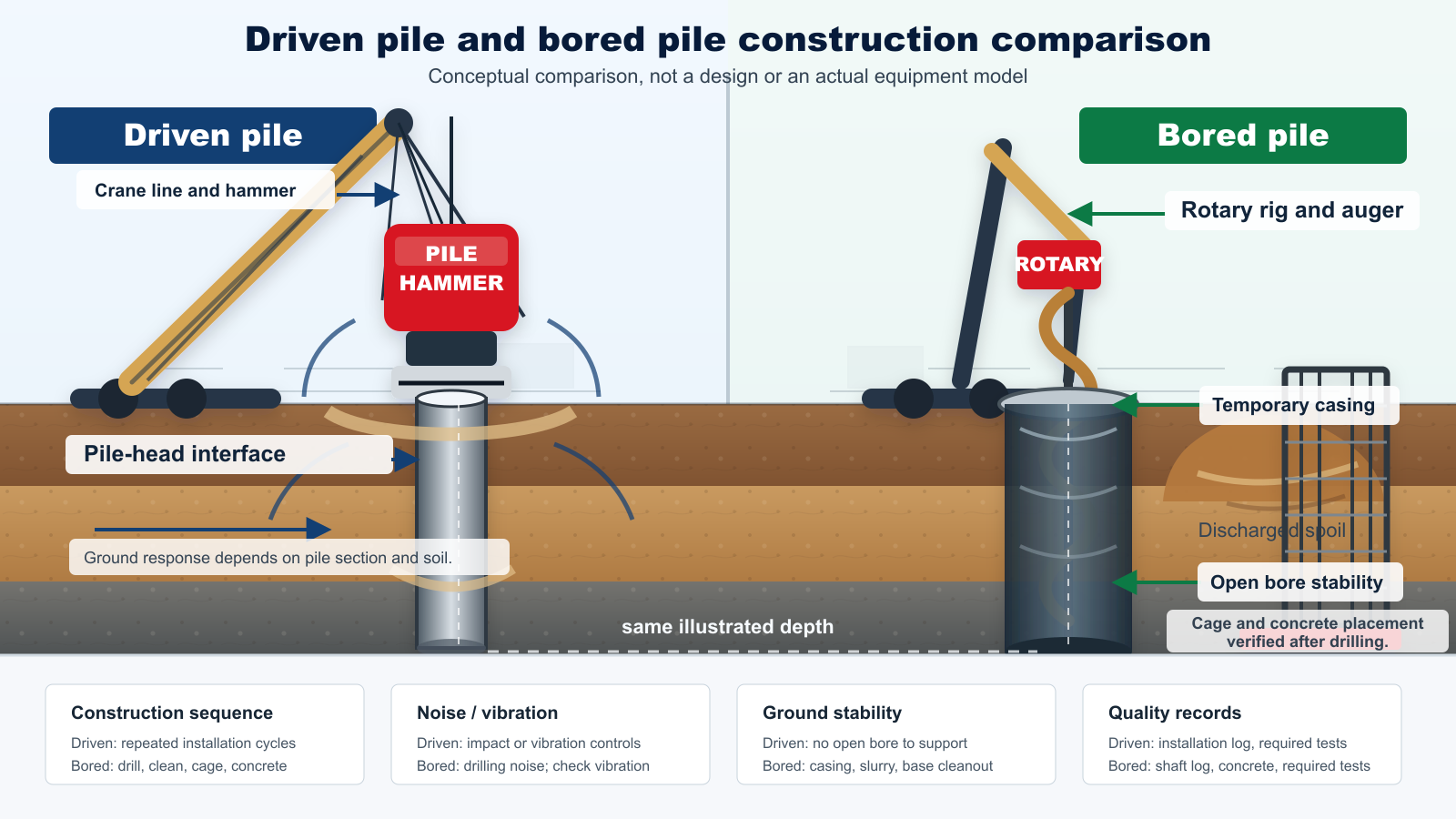
Method comparison
Construction sequence and quality checks
Compare the installation sequence, construction risks, and inspection requirements for each method.
InstallationPreformed pile or excavated shaft
Driven checksDriving records and specified tests
Bored checksConstruction records and specified tests
Driven piles
Crews install driven piles by impact or vibration. Press-in and jacking systems use static force. Soil displacement varies: H-piles and unplugged open-ended pipes displace less soil than closed-ended piles.
Installation recordsDepth, resistance, hammer settings, and pile condition
Construction risksNoise, vibration, refusal, alignment, and pile stress
Capacity checksSpecified engineering analysis and load tests
- 1Deliver and pitch the pile
- 2Align the leader, guide, clamp, or drive cap
- 3Install by impact or vibration using the specified sequence
- 4Record depth, resistance, hammer settings, and pile condition
- 5Complete specified testing, cutoff, and connection work
Bored piles and drilled shafts
Crews excavate and support the shaft, clean the base, lower reinforcement, and place concrete. This conventional sequence differs from CFA construction.
Construction recordsBore support, base condition, reinforcement, and concrete placement
Construction risksBore instability, groundwater, base sediment, and concrete defects
TestingSpecified load tests and integrity checks for their separate purposes
- 1Excavate the bore and maintain support as excavation advances
- 2Check casing or slurry controls and groundwater conditions
- 3Confirm depth and clean the base
- 4Lower reinforcement and place concrete by the specified method
- 5Review construction records and complete the specified tests
Method family and equipment scope
Confirm the equipment included in the quotation, including separate drilling, casing, hydraulic, and concrete placement requirements.
| Method family | Typical forms | Construction sequence | BRUCE equipment scope |
|---|---|---|---|
| Driven piles | Steel H-piles, pipe piles, precast concrete piles, timber piles; sheet piles for retaining work | Crews install a preformed element and record driving response | Review SGV for suitable steel driving or extraction and SGH for impact driving |
| Conventional bored piles | Bored piles, drilled shafts, rock-socket shafts | Crews excavate a shaft, then place reinforcement and concrete | SGV may support suitable casing installation or extraction |
| CFA piles | Continuous flight auger and augered cast-in-place piles | Crews pump concrete or grout during auger withdrawal, then insert reinforcement | The drilling and pumping package requires separate review |
| Combined methods | Vibration followed by impact, predrilling followed by driving, casing-assisted boring | The designer and contractor define the purpose and checks for each stage | Confirm the hammer, casing interface, and hydraulic supply for the specified work |
Performance and constructability
Check construction requirements against the site conditions, inspection plan, and total foundation cost.
| Comparison item | Driven piles | Bored piles / drilled shafts / CFA | Checks before selection |
|---|---|---|---|
| Production | Account for pile delivery, handling, driving conditions, splicing, and work restrictions. | Account for drilling, bore support, spoil handling, reinforcement, concrete supply, and inspection. | Compare the full schedule for the required foundation, including mobilization and testing. |
| Loads and layout | Engineers select pile sections, lengths, quantities, and groups for the design loads and ground conditions. | Engineers can consider large-diameter shafts where the loads, ground, and site allow them. | Check axial, lateral, and uplift loads, settlement, pile-group behavior, and pile-cap design. |
| Noise and vibration | Impact and vibratory installation can require restrictions and monitoring near sensitive structures. | Drilling can reduce vibration compared with impact or vibratory driving. Hammer-driven or extracted casing can still generate vibration. | Define noise and vibration limits, monitoring, work hours, and contingency methods. |
| Groundwater and spoil | Driving without predrilling can limit excavated spoil. Soil displacement depends on pile form and plugging and can affect nearby ground. | Conventional bored work can require casing or slurry, controlled concrete placement, and spoil handling. CFA work requires pumping and withdrawal controls. | Plan groundwater control, construction support, spoil handling, and inspection for the chosen sequence. |
| Quality evidence | Engineers interpret driving records, hammer data, pile inspections, and specified dynamic or static tests. Driving set alone does not prove capacity. | Inspectors review bore or auger records, reinforcement and concrete records, and specified tests. Integrity tests assess defects or continuity, not geotechnical capacity. | Define construction acceptance and load verification requirements before production. |
BRUCE equipment scope
QA and risk control
Driven pile equipmentSGV and SGH package review
BRUCE supplies SGV vibratory hammers for suitable steel pile driving and extraction and SGH hydraulic impact hammers for impact driving. Confirm the hammer, pile interface, hydraulic supply, and lifting requirements for the work.
Bored pile equipmentSeparate casing and drilling requirements
SGV equipment may support suitable casing installation or extraction. For a BRUCE hydraulic rotary head, confirm the tooling interface, power supply, and host rig as a separate drilling package; the head alone is not a complete rig. Hammer-driven or extracted casing can generate vibration even when the main pile requires drilling.
Core definition
Crews drive preformed piles by impact or vibration. Press-in and jacking systems use static force, while screw and helical piles use rotation. Driven cast-in-place systems use a driven shell or casing and a specified concreting sequence. Closed-ended piles can displace substantial soil; H-piles and unplugged open-ended pipe piles displace less soil.
A conventional bored pile or drilled shaft requires crews to excavate a hole, support the bore as needed, place reinforcement, and place concrete.
Driven pile method and equipment
Crews deliver and pitch the pile, align it with a leader or guide, and install it with the selected equipment. They record depth, driving resistance, hammer settings, and pile condition and complete the specified testing and connection work. For impact driving, check the drive cap or helmet and the hammer cushion where the hammer design requires one.
Concrete piles may also require a separate pile cushion between the helmet and pile head. Driving set and blow count require engineering interpretation; they are not stand-alone proof of capacity.
Bored pile and drilled shaft method
For a conventional bored pile or drilled shaft, crews excavate and support the bore with casing or slurry where needed, check depth and base cleanliness, lower the reinforcement cage, and place concrete using the specified dry or wet method. Under water or slurry, they use the specified tremie procedure. Inspectors review excavation, slurry, reinforcement, and concrete records and carry out the specified tests.
CFA piles use a different sequence: crews drill with a hollow-stem auger, pump concrete or grout as they withdraw it, and insert reinforcement into the fresh material. Integrity tests assess defects or continuity; they do not establish geotechnical load capacity.
Frequently asked questions
Are driven piles better than bored piles?
The choice depends on ground conditions, design loads, site restrictions, and construction controls. Compare the full foundation system, its cost, and its inspection and testing requirements.
When should engineers consider bored piles?
Engineers may consider bored piles where driven-pile vibration would breach project limits or where the design requires large-diameter shafts. They must assess bore stability, groundwater control, concrete placement, and inspection. Casing installation or extraction with a hammer can still generate vibration.
How should foundation costs be compared?
Compare total foundation cost, including pile quantity, pile caps, mobilization, installation, testing, and environmental controls. For bored work, include spoil handling, casing or slurry, and concrete supply. A lower price per pile may not produce a lower project cost.
What information is needed for a BRUCE review?
Start with the pile details, available soil information, and planned installation method. Include site restrictions and any casing installation or extraction work.
Technical basis
Sources supporting the technical claims above.
Discuss Your Piling Equipment Needs
Send the pile details, available soil information, and planned installation method. The BRUCE team can discuss the equipment required for the work.