What is Piling? The Comprehensive Guide to Deep Foundation Engineering
I. The Theoretical Physics of Deep Foundations
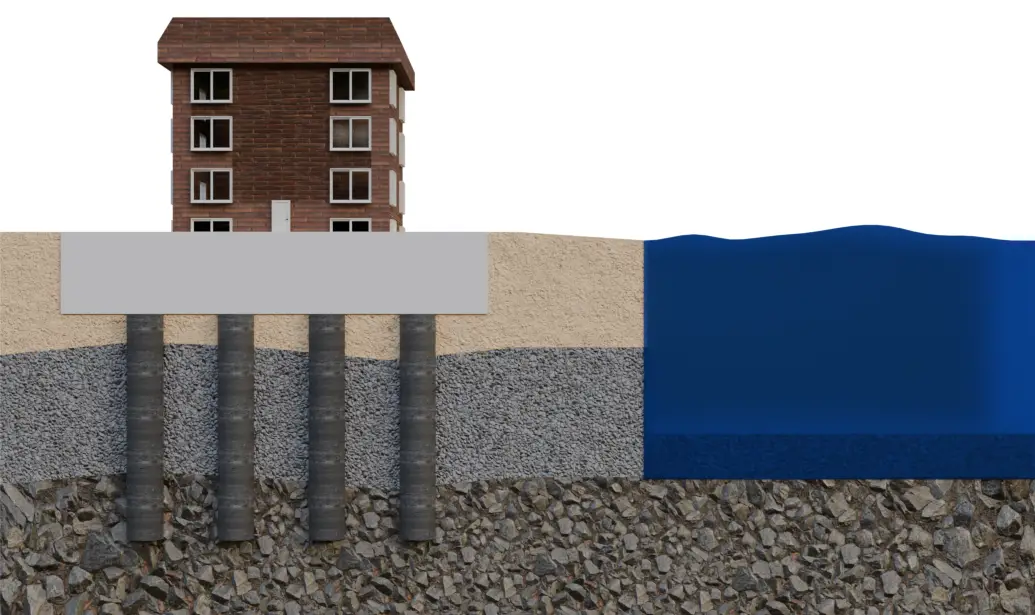
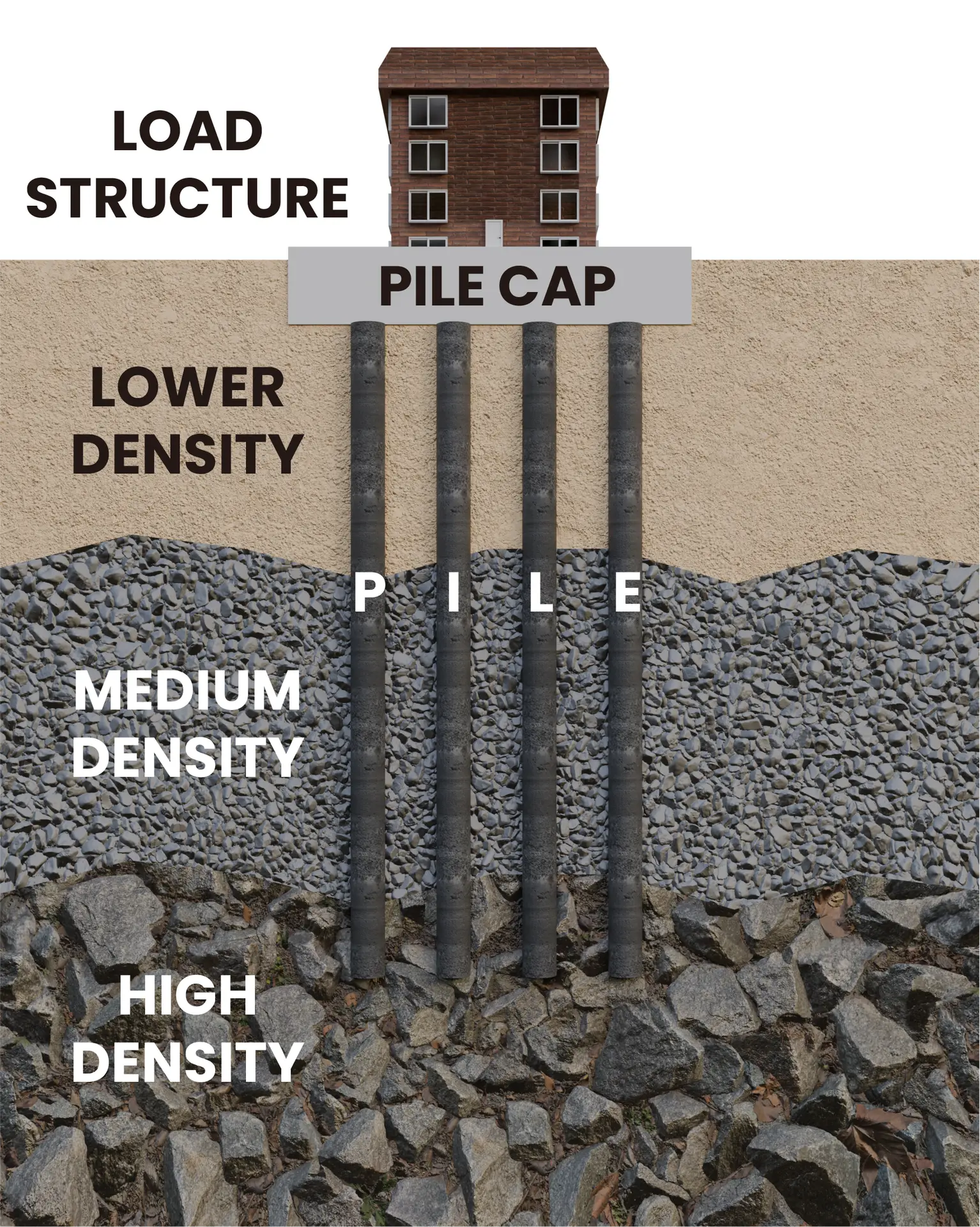
In construction, deep foundations is a method where long cylindrical supports made of wood, concrete, or steel are driven into the ground. Long cylindrical piles are driven deep into the ground to create a firm, stable layer of soil at the construction site — in situations such as weak ground or heavy building loads. This allows a stable structure to be built as the load of the building is spread over several installed piles.
A "perfect foundation" is mandatory when the surface soil possesses low bearing capacity or high compressibility. Without these deep supports, heavy building loads would cause differential settlement — leading to structural cracks or collapse. Piles act as structural columns driven into the ground, dispersing the load through two primary mechanisms: End-Bearing (transferring weight to a solid rock layer) and Friction (utilizing the surface adhesion between the pile and the surrounding soil).
When Should This Technique Be Used?
- Around Water: Coastal or riverine sites may require this method to mitigate flooding risks and provide a stable foundation despite rising water levels. Explore our Marine Piling Solutions for more.
- For Uneven or Heavy Loads: If there is a heavy object such as specific equipment in a certain part of the building structure, the weight is not evenly distributed. In this case, the foundation can distribute the load evenly to prevent settlement.
- Low-Density Soil Conditions: If the soil at the site is of low density, it can be easily compacted. In this case, piles are installed up to the high-density soil to ensure the stability of the building.
- Groundwater and Moisture: If there is groundwater or drainage systems around the building, it may be difficult to keep the ground dry. Pile foundations are used to overcome this situation.
II. Classification of Piling Materials and Engineering Choice
Piles are made from a variety of materials rather than just one type. Because every site is different in terms of soil density, characteristics, and external factors, they are categorized to ensure they are installed in the right place.
1. Concrete Piles: Precast vs Cast-in-place
Precast Concrete Piles: These are prefabricated to the size appropriate for the construction environment. Because of the nature of concrete, it is resistant to deformation under impact and can be installed under water. The prefabrication method speeds up work as piles can be made before construction starts. However, it is important to know the exact length in advance to prevent damage during transport. BRUCE SGH hydraulic impact hammers drive precast concrete piles in round, square, and octagonal profiles — with drive cap and cushion configurations confirmed at order stage before dispatch.
Cast-in-place Concrete Piles: These are made at the same time as the foundation by drilling a hole in the ground and pouring concrete. This method allows the length and number of piles to be adjusted to suit the site. However, the strength can be slightly lower than prefabrication — so site management and process monitoring are essential.
2. Steel and Timber Piles
Steel Piles: Capable of withstanding large loads, steel piles are mainly used for large structures. BRUCE SGV vibratory hammers use Universal Sheet Pile Clamps (60U to 320U) for AZ/PZ flat sheet pile profiles and Casing Pile Clamps (2x40D to 4x160D) for round steel pipe piles. BRUCE SGH impact hammers have driven steel casings up to 72 inches in diameter — demonstrated on the Sakonnet River Bridge (Rhode Island, USA).
Timber Piles: Installed in dense soils below the water table, these are used in temporary structures and structures with medium loads.
III. Considerations for Successful Piling Operations
Successful foundation engineering requires a synergy between investigation and control. The following factors are critical for ROI and site safety.
- Geotechnical Investigation: Detailed site investigation is essential. Soil borings, laboratory tests, and field penetration tests (SPT, CPT) help determine the soil profile and bearing capacity. For vibratory hammers, the selection rule: centrifugal force should be at least 15 times the pile weight.
- Design and Load Calculations: Structural engineers collaborate with geotechnical experts to determine the required pile diameter, length, and material. Designs must account for axial load, lateral load, seismic forces, and potential uplift.
- Environmental and Noise Constraints: Urban environments may require low-noise or low-vibration solutions like the BRUCE SGV Series — which operates at 1,380 to 2,000 vpm (crane) or up to 3,300 vpm (excavator) with no smoke. See our 7 Key Differences Guide for equipment selection.
- Quality Control: During and after installation, load tests (static and dynamic) verify performance criteria. The optional BRUCE IEA (Impact Energy Analysis) System records real-time energy at every blow — adopted as standard by the Hong Kong Housing Government — supporting ASTM D4945 dynamic pile monitoring for structural sign-off.
- Maintenance and Monitoring: While piles are generally permanent, structures may require periodic inspection in seismic regions or areas with groundwater fluctuations. Monitoring instruments can detect subtle movements or changes in load distribution.
IV. Advanced Equipment for Pile Installation
How a pile is installed dictates the site's productivity. BRUCE Piling Equipment — ISO 9001 certified since 2004, with 27 years manufacturing experience — provides the global standard in high-performance installation assets across more than 80 countries.
Hydraulic Vibro Hammers (SGV Series)
Ideal for precise driving in granular soils where soil liquefaction eliminates skin friction. Centrifugal force: 510 kN (SGV-80) to 4,610 kN (SGV-2000). Extraction capability: line pull 25 to 180 tons. Compatible with biodegradable hydraulic oils. Explore the Vibratory Hammer Cornerstone.
Hydraulic Impact Hammers (SGH Series)
Deliver discrete percussive strikes for hard rock, dense clay, and final end-bearing verification. Energy range: 8.4 ton.m (SGH-0712) to 89.3 ton.m (SGH-4719). Optional BRUCE IEA System records real-time energy at every blow. View our Impact Hammer Handbook.
Auger Drills
Used in bored piling, these drills remove soil to create a hole for concrete and reinforcement. They can be continuous flight augers (CFA) or sectional augers depending on project constraints.
V. Frequently Asked Questions
Ready for an Engineering-Matched Quote?
Ensure your next infrastructure project is executed with precisely specified piling technology and direct manufacturer engineering support.
Request Specifications & Quotes