BRUCE Technical Team
Vibro Hammer Selection
Hammer Principles and Selection
Vibro Hammer Selection
Select a vibro hammer by checking the proposed installation or extraction method against the pile, ground and project requirements. Then match the hammer ratings, clamp, hydraulic source and lifting arrangement to that duty. Confirm the site limits and required records before recommending a model; catalog force alone cannot establish suitability.Check the pile, ground and permitted method, then match the hammer, clamp, hydraulics and lifting duty to the site limits and acceptance requirements.
Confirm the dutyPile, ground and permitted installation or extraction methodMatch the packageHammer ratings, clamp, hydraulics and lifting arrangementDefine the evidenceSite limits, records and project acceptance
Technical guide
Article information
Technical review policy. BRUCE prepares this reference from the cited material. Project-specific design and approval remain with the responsible project team.
Planning overview
Engineers review the pile drawing and ground investigation before choosing a vibratory method. The equipment supplier then checks the candidate hammer, clamp and hydraulic package against that duty.
The project team must resolve lifting, site limits and acceptance requirements alongside the equipment review.
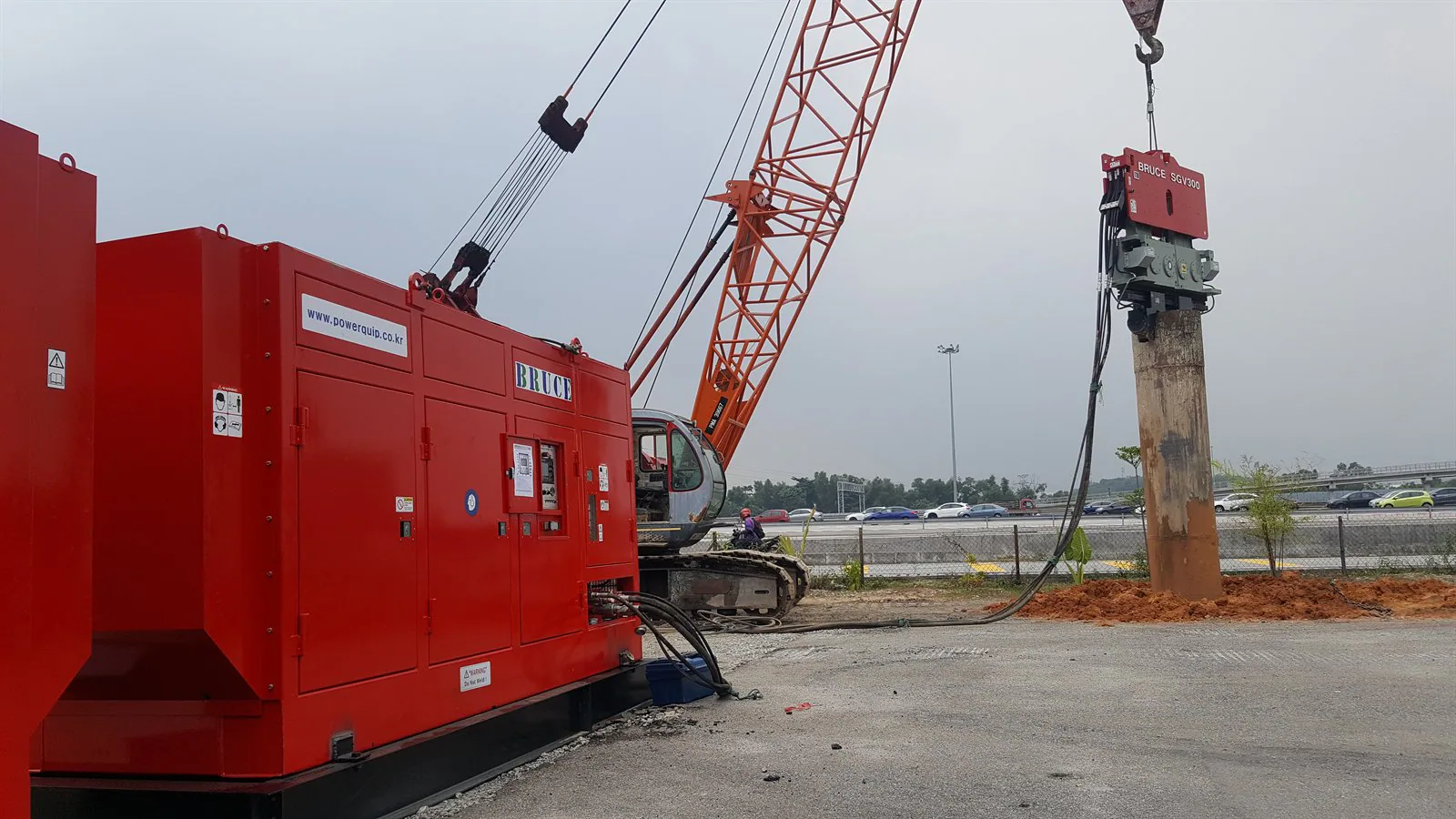
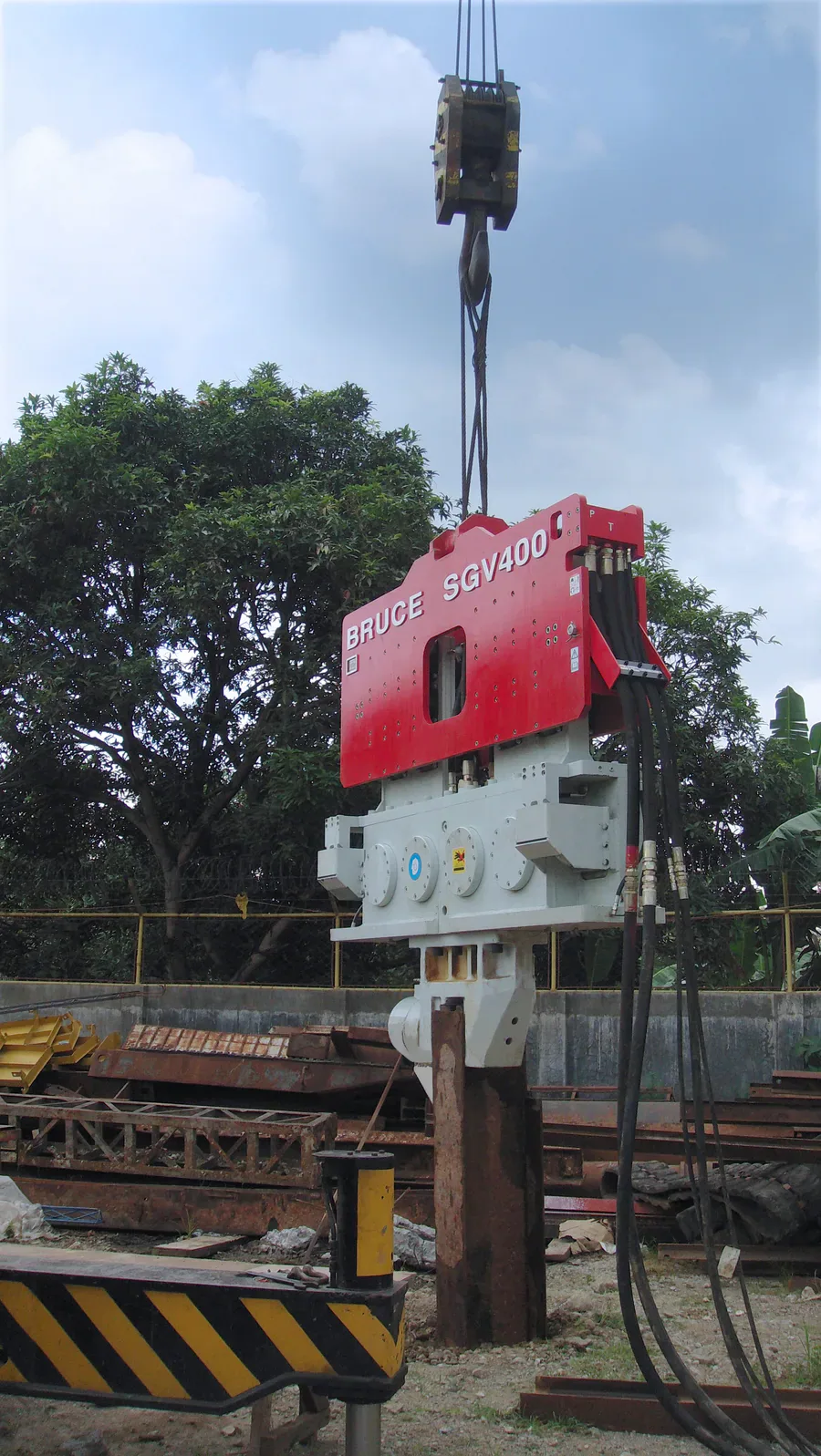
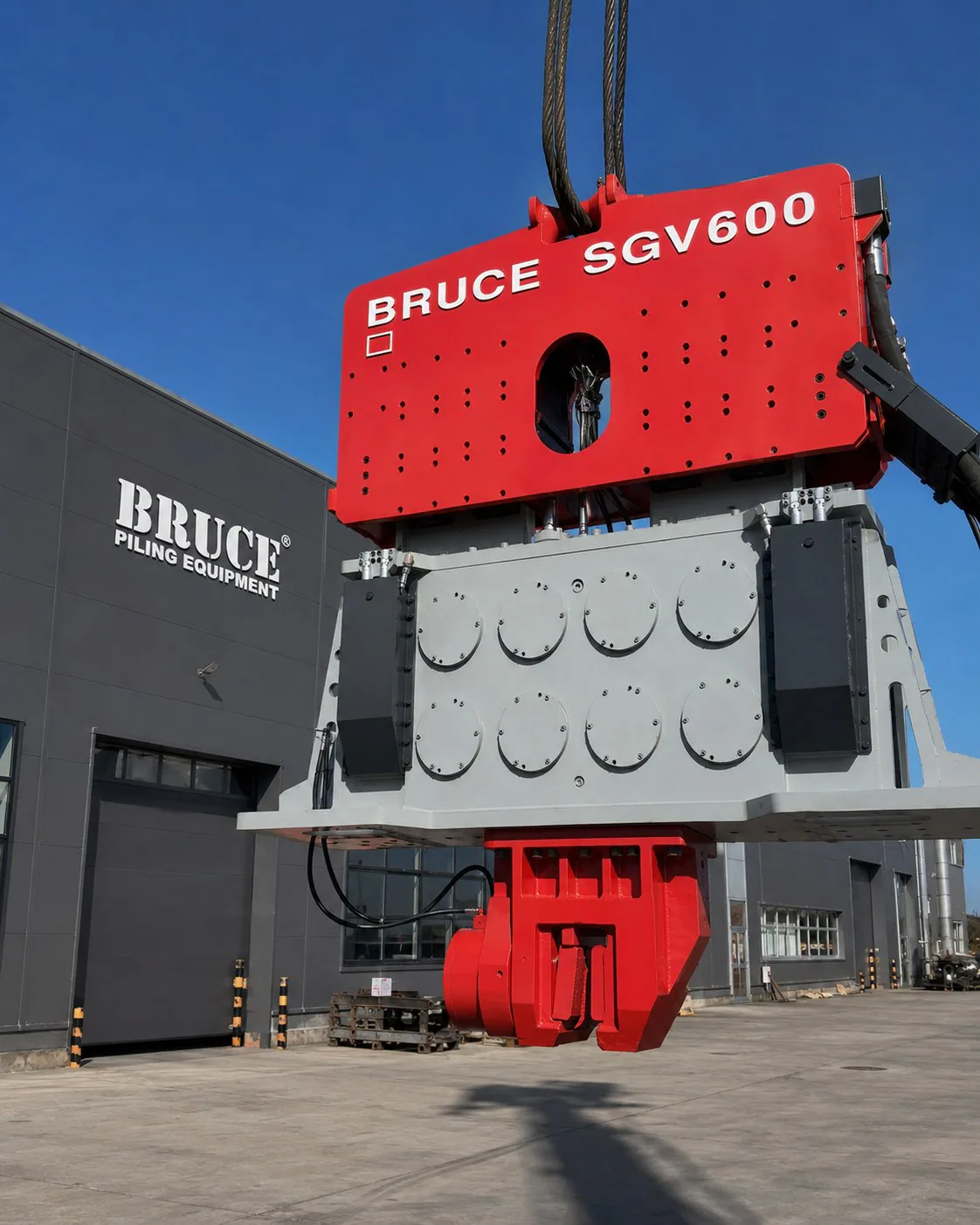
These BRUCE photographs show visible equipment and site arrangements. They do not establish internal condition, approved lifting duty, measured performance or pile capacity.
Selection checks
Check the complete operating package
Use this table to organize the review with the equipment supplier and responsible project team.
| Review area | Information to check | Decision |
|---|---|---|
| Pile and purpose | Drawing, material, dimensions, condition, target depth and installation or extraction duty | Confirm the permitted method and project completion criteria |
| Ground | Depth-based investigation, groundwater, resistance changes and obstructions | Define uncertainty, trial requirements and method contingencies |
| Hammer ratings | Eccentric moment, force, frequency, amplitude convention and vibrating mass | Compare definitions and units for the exact configuration |
| Clamp and contact | Jaw geometry, grip area, pile stiffness, wear and load direction | Obtain manufacturer confirmation of the attachment and pile interface |
| Hydraulic supply | Required flow and pressure, return limits, hoses, couplers, cooling and controls | Verify the proposed operating duty and hose layout |
| Lifting and extraction | Supported load, crane chart, radius, rigging, load path and release effects | Approve the lift and any extraction duty as separate load cases |
| Site and acceptance | Noise, vibration, movement, monitoring, records and required tests | Set action thresholds, stop authority and acceptance requirements |
Field checks
Verify the proposed arrangement before and during work
Confirm the installation method
Engineers first check whether the project permits vibratory installation or extraction for the proposed pile. Steel sheet piles, H-sections, pipe piles and casing can be candidates, but the section name alone does not establish suitability. Review the pile material, stiffness, dimensions, connections, target depth and construction role with the ground investigation.
Compare soil layers, groundwater, dense zones, cohesive material, fill and obstruction records by depth. A soil description, one SPT N-value or one CPT peak cannot select a hammer model. Where uncertainty affects the method, the project team should define the required investigation, trial work or contingency. Dense ground or slow movement does not authorize a larger hammer, more crane pull or an unapproved method change.
A permanent load-bearing pile also needs the installation and acceptance procedure that its design and project specification require. Vibratory installation is not limited to temporary work. Precast or prestressed concrete needs separate pile-designer and manufacturer review for potential tensile and bending damage; this guide does not recommend an SGV package for that duty.
Impact finishing belongs in the plan when the approved method or specified evidence requires it; it is not a universal consequence of foundation purpose.
Read each hammer rating on its own basis
The manufacturer states eccentric moment, rotational frequency, force, amplitude and vibrating mass for a defined configuration. Eccentric moment describes unbalanced rotating mass and its offset. Frequency describes the rate of excitation. A published amplitude may describe a specified vibrating mass in a free-hanging condition; confirm whether it means zero-to-peak or peak-to-peak movement.
Use the same definitions and units when comparing candidate equipment. Clarify whether the stated vibrating mass includes a clamp or attachment. That mass basis differs from the gross load supported by the crane. The pile and surrounding ground alter the motion that occurs during work, so a catalog amplitude or force value cannot predict penetration, extraction or load-bearing capacity.
Ask BRUCE for the current model sheet and operating instructions for the exact hammer and attachment. Confirm the units, definitions and permitted configuration before comparing candidate models.
Check the clamp and pile contact
Match the jaw or approved attachment to the pile drawing, contact area, wall or flange thickness, stiffness, condition and intended load direction. Review coatings, wear, interlocks, splices and clearance where they affect grip or alignment. Round pipe and casing work may need a purpose-designed clamp or beam arrangement.
The manufacturer must confirm the permitted hammer, clamp and attachment combination. Keep clamp gripping force, cyclic exciter force and static line pull as separate ratings. A higher grip rating does not establish crane capacity or justify an unverified pile contact. Inspect the contact and pile during work; clamp slip, eccentric grip or local damage requires a stop and assessment under the approved procedure.
Match the hydraulic source and hose layout
Check required flow and pressure for the selected operating condition, including any simultaneous functions. Confirm the permitted return pressure, hose and coupler ratings, oil specification, temperature range, cooling capacity and controls. The power pack or carrier must support the proposed combination within the manufacturer’s operating limits.
Hose diameter, length, routing and couplers affect pressure loss and return restriction. Keep the planned hose layout in the equipment review rather than treating it as a site accessory. Engine output or the power pack’s nameplate value does not establish the hydraulic supply available at the hammer. The supplier should confirm the duty point and any required hose or cooling changes before mobilization.
Assess lifting and extraction as separate duties
The lifting plan must use the actual supported load and crane configuration. Include the hammer, clamp, attachments, rigging, supported hose weight and any pile load carried in that operation, with the load-chart deductions and other allowances that the crane instructions require. Check the working radius, boom, headroom, ground support and permitted piling duty with the responsible lifting team.
For extraction, assess pile condition, connections, embedment, time in the ground and the expected resistance. Review the complete load path, equipment line-pull limits, crane and rigging limits, and the effect of release. A hammer’s maximum line pull is an equipment limit, not a guaranteed breakout force or crane capacity. Account for vibratory duty and sudden release in the approved lift and extraction plan.
A stuck or slow-moving pile requires the responsible person to assess the cause. Increasing crane pull without that assessment can overload another part of the system before the pile moves. Define how the team will stop, secure the equipment and obtain approval for a revised method.
Set site limits before choosing operating settings
Review nearby structures, utilities, sensitive equipment, access and the ground conditions that could permit settlement or movement. The project team must define applicable noise, vibration and movement criteria, monitoring locations, action levels and stop-work responsibilities. General source-level tables support screening; they do not establish a safe distance or predict compliance for a BRUCE model.
A high-frequency or variable-moment machine does not remove the need for this review. The team should assess startup, shutdown and operating conditions with the equipment supplier and project specialists. If the planned work cannot meet the site limits, compare permitted alternatives or a revised sequence before selecting a different hammer.
Agree the records and acceptance procedure
Record the pile identity, depth and time, hammer and clamp configuration, operating settings, hydraulic condition, interruptions and relevant monitoring. The project specification should state any trial work, inspection, testing and acceptance required. Keep installation progress separate from foundation capacity: penetration rate alone does not establish load-bearing capacity.
Operators must use the model instructions and approved work and lift plans. Define stop conditions for clamp slip, loss of alignment, pile damage, abnormal noise or movement, hydraulic leakage, overheating and project monitoring thresholds. Secure the equipment and isolate stored energy as the manufacturer requires before inspection or maintenance.
A BRUCE equipment review can identify candidate hammer, clamp and hydraulic packages from the information supplied. The responsible project and lifting teams retain the design, method, lift and acceptance decisions. Assign each missing input to the responsible project team member or supplier before the team approves a purchase or operating plan.
Frequently asked questions
Can catalog force select the hammer model?
Catalog force describes one equipment rating under stated conditions. Engineers must also review the pile and ground response, rating definitions, attachment, hydraulics, lifting duty and site limits. A larger force number does not establish a suitable package.
Does a permanent foundation require impact driving?
The design and project specification determine the permitted installation and acceptance procedure. Vibratory installation can form part of permanent pile work where the project permits it. Include impact driving or testing when the approved procedure requires it.
Can maximum line pull predict extraction?
Maximum line pull is an equipment limit. Extraction also depends on the pile condition, ground resistance and complete load path. The lifting team must check crane and rigging limits, vibratory duty and release effects in the approved extraction plan.
What should I send for an equipment review?
Start with the pile drawing, available ground information and a site photo. State whether the work includes installation, extraction or both. BRUCE can identify the additional information needed for a candidate hammer, clamp and hydraulic package.
Technical basis
Sources supporting the technical claims above.
- FHWA GEC-12, Design and Construction of Driven Pile Foundations, Volume I
- FHWA GEC-12, Design and Construction of Driven Pile Foundations, Volume II
- FTA Transit Noise and Vibration Impact Assessment Manual
- Federation of Piling Specialists, Notes for Guidance on the Extraction of Temporary Casings and Temporary Piles Within the Piling Industry, Edition 1, June 2010
- HSE INDG291, Providing and using work equipment safely: maintenance and isolation
Discuss Your Vibro Hammer Package
Send a pile drawing, available ground information and a site photo. Tell us whether you need installation, extraction or both so BRUCE can review a candidate equipment package.