BRUCE Technical Team
Vibro Hammer Working Principle
Hammer Principles and Selection
Vibro Hammer Working Principle
A hydraulic vibro hammer uses motors to rotate synchronized eccentric weights in opposite directions. Their vertical force components combine while their horizontal components cancel in the intended balanced arrangement. The exciter housing and clamp transfer cyclic force into the pile. The pile’s movement then depends on the hammer, pile and ground together; a catalog force rating cannot predict penetration or extraction on its own.A hydraulic vibro hammer uses synchronized counter-rotating eccentric weights to generate vertical cyclic force. The clamp transfers that force to the pile; pile and ground conditions control the resulting movement.
Generate forceHydraulic motors and synchronized eccentric weightsTransfer forceExciter housing, clamp and pile contactCheck responseGround, lifting duty, monitoring and records
Technical guide
Article information
Technical review policy. BRUCE prepares this reference from the cited material. Project-specific design and approval remain with the responsible project team.
Planning overview
The operator supplies hydraulic power to the exciter. The synchronized eccentric weights generate cyclic force, and the clamp transfers it into the pile. The suppressor reduces transmission toward the crane through a separate suspension path.
The project team must assess the ground response and operating limits before choosing the hammer and settings.
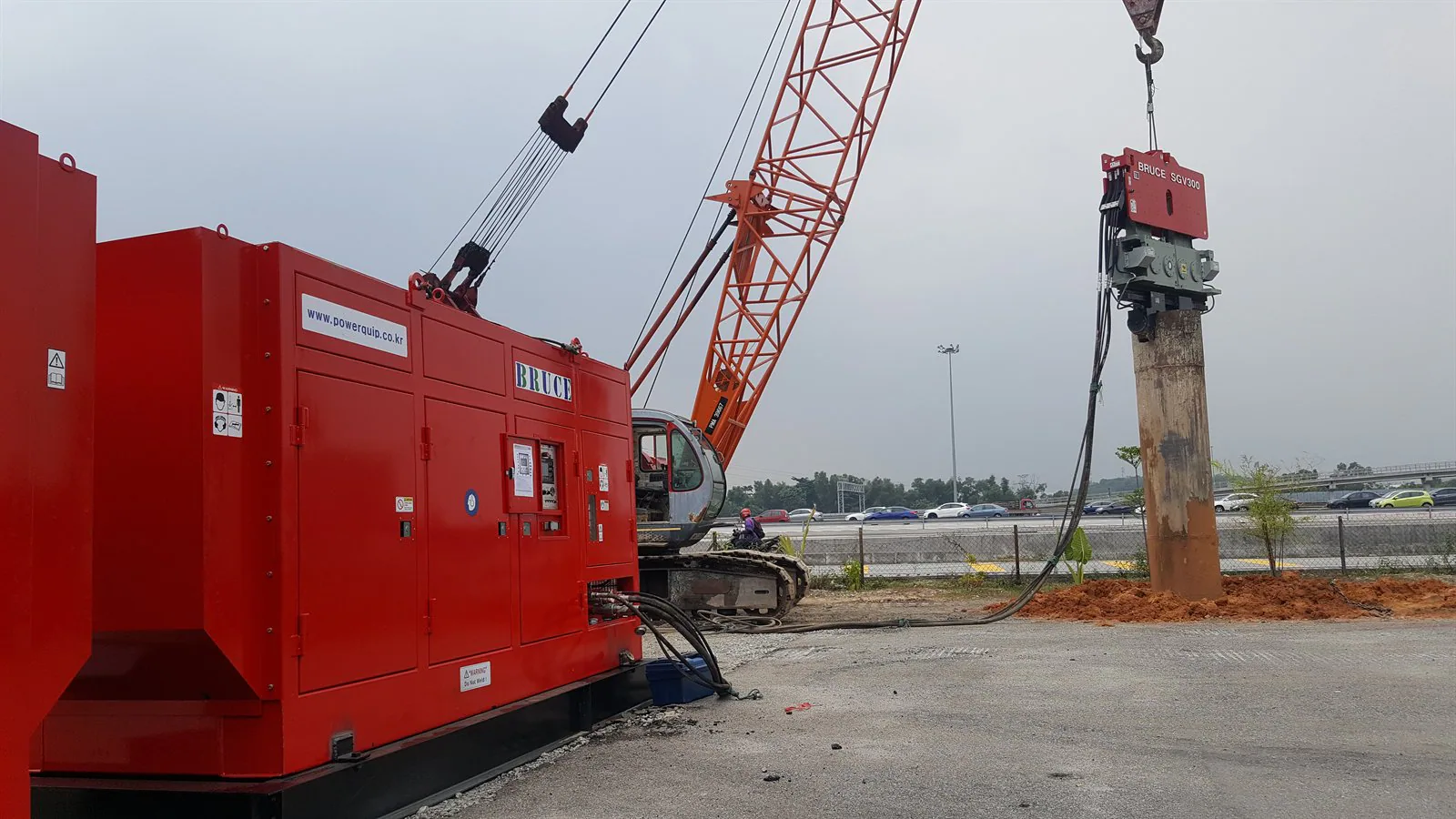
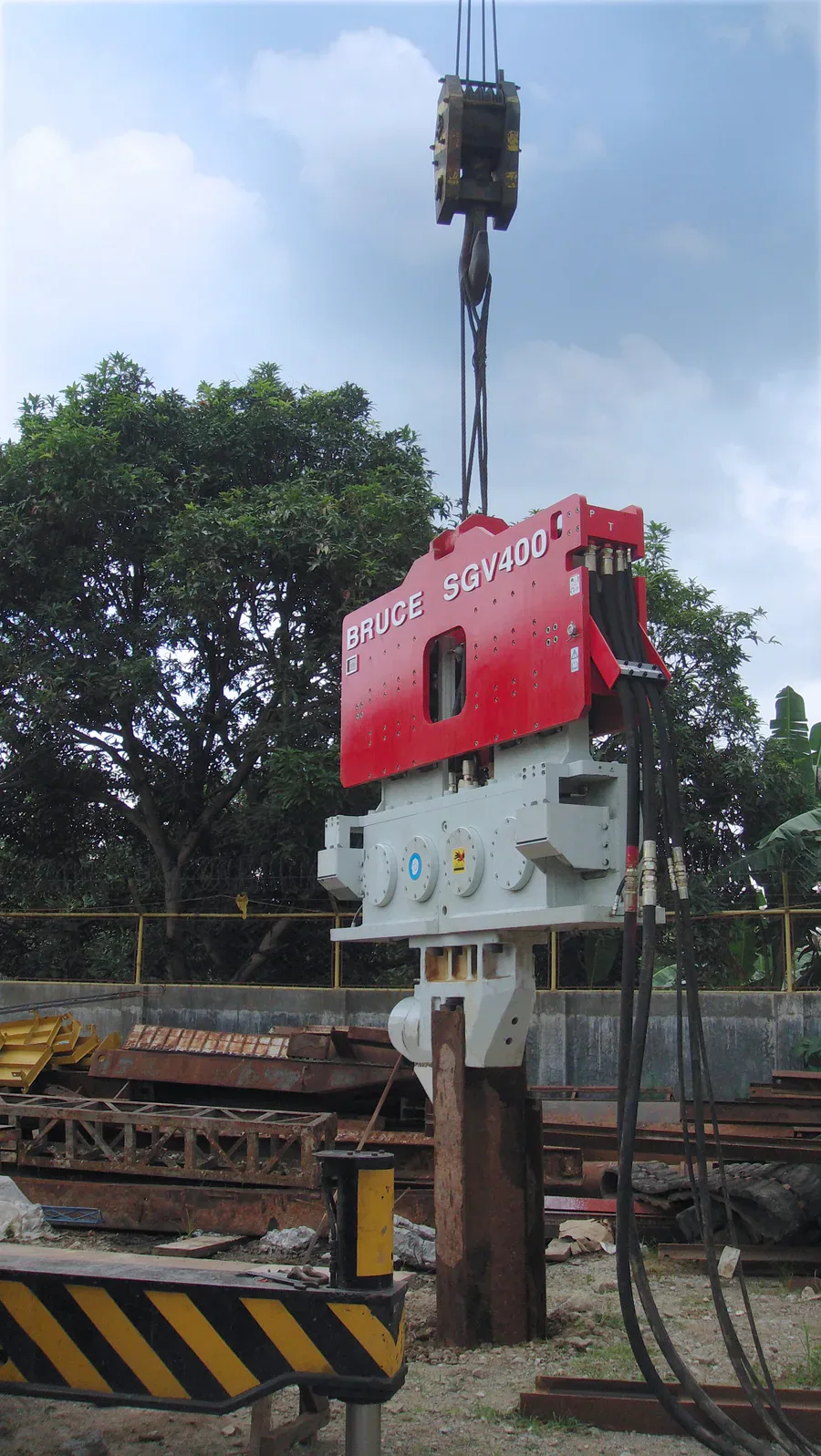
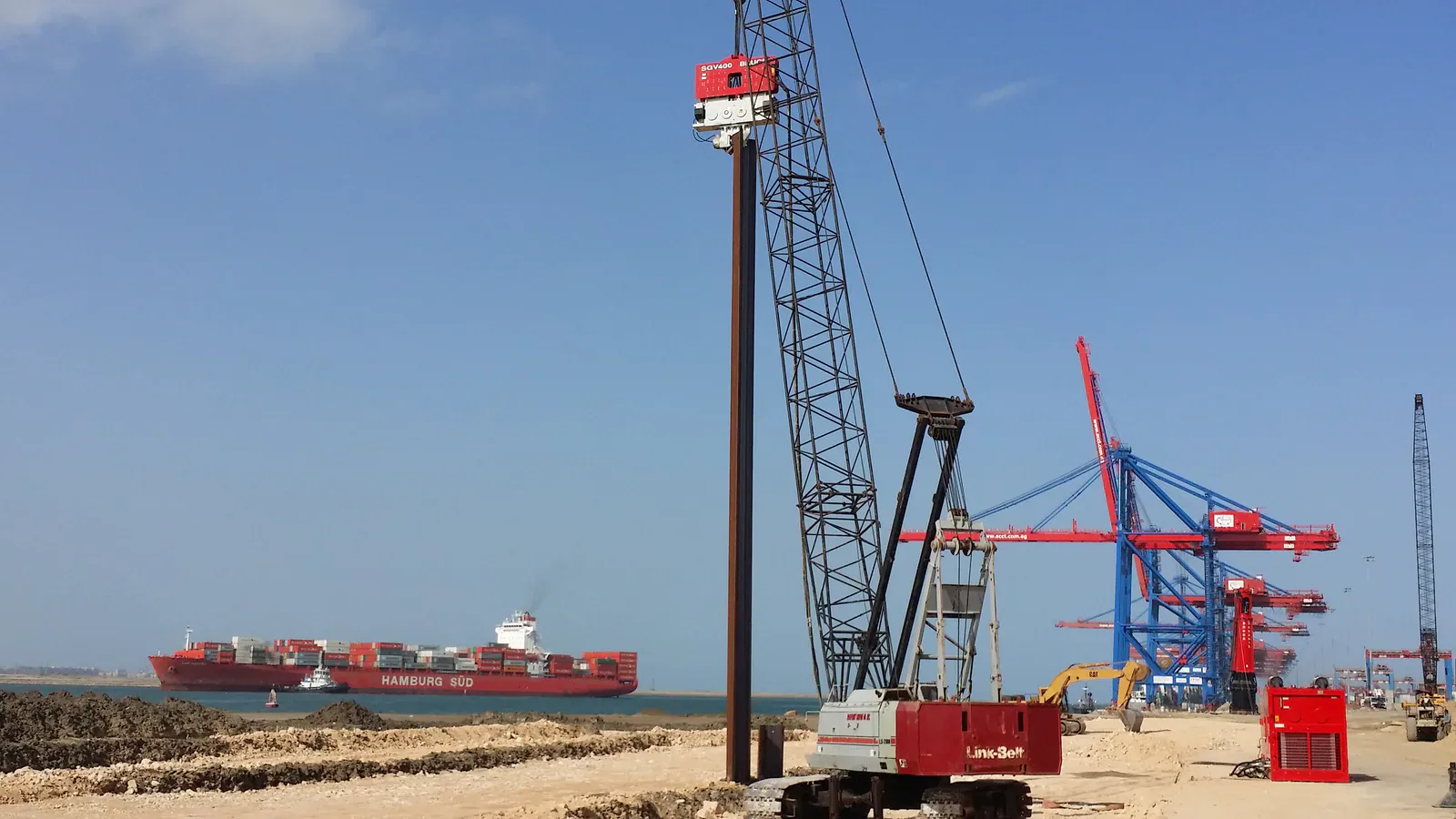
These BRUCE equipment photographs show visible site arrangements. They do not establish motion, driving direction, lifting approval, measured performance or pile capacity.
Force and reaction paths
Exciter, clamp and pile
The exciter applies cyclic force through the clamp to the pile. The suppressor reduces transmission along the suspension path toward the crane. Check both paths without treating the suppressor as part of the serial exciter-to-pile connection.
System checks
Review each interface
| Component | Function | Check before use |
|---|---|---|
| Exciter | Synchronized eccentric rotation generates vertical cyclic force | Model manual, frequency and eccentric-moment definitions, bearings, gears and abnormal response |
| Clamp and pile | The clamp transfers exciter force through its contact with the pile | Pile drawing and condition, jaw fit, hydraulic grip, contact, slip and local damage |
| Suppressor and suspension | Isolation limits transmission toward the crane while the rigging supports the equipment | Approved lifting duty, working radius, rigging, isolator condition and extraction loads where relevant |
| Hydraulic supply | The power pack supplies the motors and clamp through the specified circuits | Required flow and pressure, hose route, couplers, return restrictions, cooling and oil condition |
| Pile and ground | The installed system responds to cyclic excitation and ground resistance | Ground investigation, depth and time records, monitoring limits, stop criteria and project acceptance |
The table explains functions and review topics. Use the model manual and the project-specific work plan for operating settings, inspection limits and authorization.
How the hammer generates and transfers force
Hydraulic motors rotate eccentric weights through the hammer’s synchronization arrangement. In the intended balanced configuration, opposite rotation cancels horizontal force components and combines the vertical components. The exciter housing transfers the alternating vertical force through the clamp to the pile. The suppressor or vibration isolator sits in the suspension arrangement and reduces transmission toward the crane. It does not eliminate vibration or authorize unrestricted crane pull.
The role of eccentric moment and frequency
Eccentric moment describes the rotating unbalanced mass and its offset. For a given eccentric moment, the ideal sinusoidal force amplitude increases with the square of rotational speed. That relationship describes exciter force, not the displacement the pile will achieve in soil. Manufacturers may state displacement amplitude for a specified vibrating mass or a free-hanging condition.
Confirm whether the value means zero-to-peak or peak-to-peak motion before comparing models. Pile mass, stiffness, damping, ground resistance and the operating system affect actual motion. A larger eccentric moment or higher frequency does not establish a better match for a particular pile.
Clamp and power pack are part of the hammer system
The clamp must grip the specified pile profile and transfer cyclic force without slip or unacceptable local damage. Check jaw geometry, contact surfaces, pressure, wear, pile wall or flange condition, and the manufacturer’s procedure. Cyclic exciter force, static line pull, clamp gripping force and crane capacity describe different loads or limits. Check each for the actual duty rather than substituting one rating for another.
The power pack must supply the hammer’s required flow and pressure within the approved operating range. Hose diameter and length, couplers, return restrictions, oil condition, temperature and cooling affect delivery. Verify the actual combination; the power pack’s nameplate output is not the hydraulic supply available at every hose layout.
Ground response and project acceptance
Vibration can reduce resistance during driving or extraction, but the response varies with soil type, density or consistency, drainage, groundwater, pile geometry and operating conditions. Dense layers, cohesive soils, cobbles, obstructions or rock can restrict movement. Review the investigation and, where the project requires them, monitored trial results.
Record penetration or extraction against depth and time alongside operating settings and relevant monitoring. Penetration rate alone does not establish load-bearing capacity. The responsible project team must define the required design checks, testing, acceptance and any change of installation method.
Inspection and abnormal response
Follow the model manual and the approved lift and work plan. Confirm the lifting duty, rigging, clamp, hydraulic connections, exclusion zone and monitoring arrangements before operation. Stop and secure the equipment for clamp slip, loss of alignment, damaged hoses, abnormal noise or movement, leakage, overheating, or a project-defined action threshold.
A slow-moving or stuck pile does not authorize more crane pull or a higher hammer setting. The responsible person must assess the cause and approve any adjustment or method change. Isolate and depressurize the hydraulic system as the manufacturer requires before maintenance.
Frequently asked questions
How does a vibro hammer generate force?
Hydraulic motors rotate synchronized eccentric weights in opposite directions. In the intended balanced arrangement, their vertical force components combine and their horizontal components cancel. The exciter housing and clamp transfer the cyclic force to the pile.
Does a higher rated force mean faster driving?
Rated force describes excitation under the manufacturer’s stated conditions. The pile’s movement also depends on the pile, clamp, hydraulics and ground. A higher force rating does not establish a faster penetration rate or a suitable equipment choice.
Does the suppressor eliminate vibration at the crane?
The suppressor reduces vibration transmission through the suspension arrangement. Its condition and the operating setup still matter. Use the manufacturer’s instructions and the approved lifting plan; isolation does not authorize unrestricted crane pull.
Can penetration rate establish pile capacity?
Penetration rate is an operating record, not a load-capacity test. The project team must define the required analysis, testing and acceptance criteria for the foundation.
Technical basis
Sources supporting the technical claims above.
Discuss Your Vibro Hammer Package
Send a pile drawing, available ground information and a site photo. Tell us whether you need driving, extraction or both so BRUCE can review the hammer, clamp and hydraulic package.