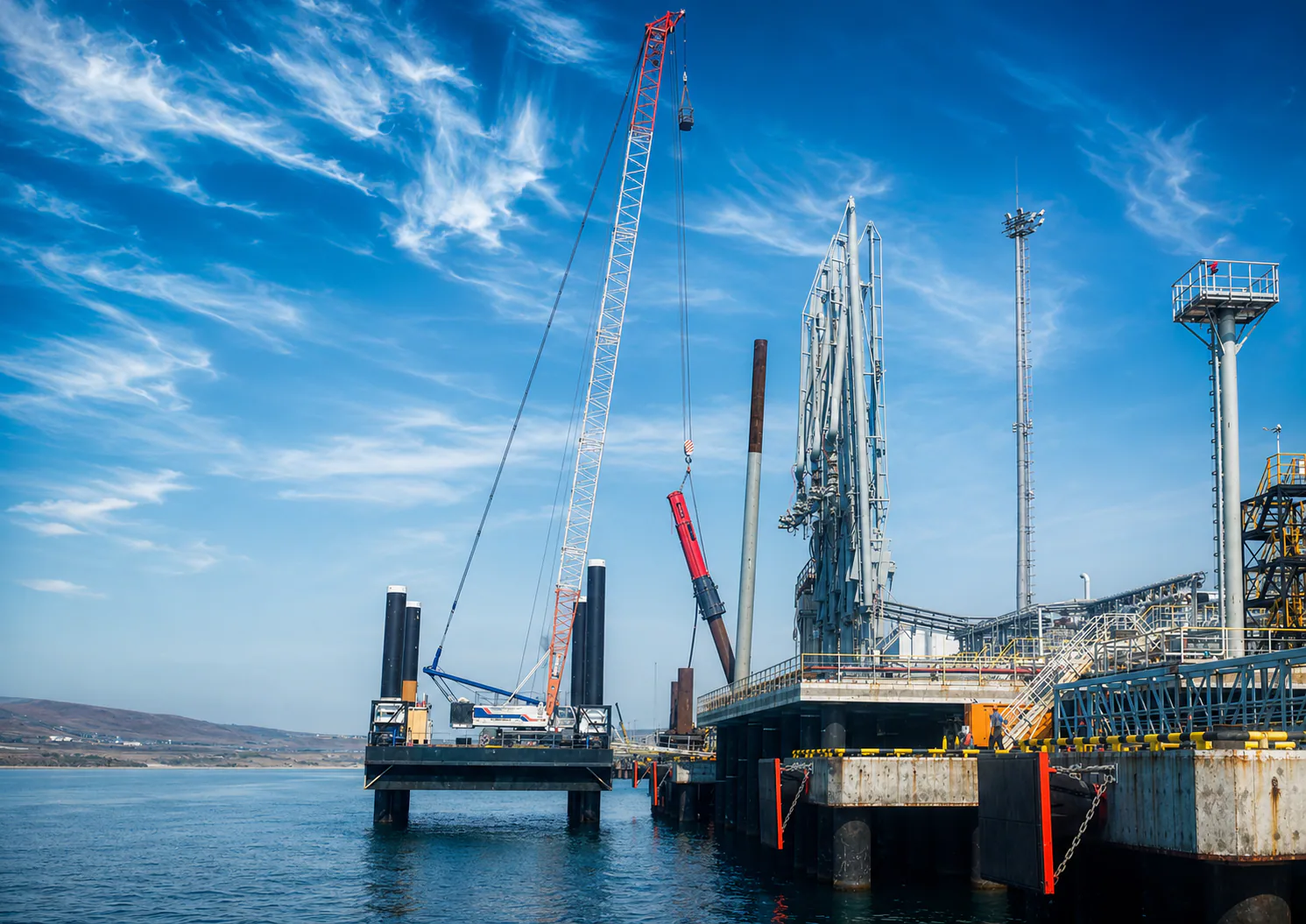
Marine pile driving installs piles at waterfront and over-water sites. The project team must match the pile and ground conditions with the vessel, lifting equipment, installation method, and environmental limits. A hammer rating alone cannot establish whether the complete operation is suitable.
Technical review policy. BRUCE prepares this reference from the cited material. Project-specific design and approval remain with the responsible project team.
Prepared by
BRUCE Technical Team
Last updatedReference setPublic technical guidance and BRUCE specifications
●Planning overview
Choose the installation sequence from the pile design, seabed investigation, and permitted site response. Check the vessel or platform, crane, guides, hammer interface, and hydraulic package together.
The team must define monitoring, stop actions, recovery, and acceptance before work starts. Operating limits and required tests come from the actual project and equipment, not from a generic marine label.
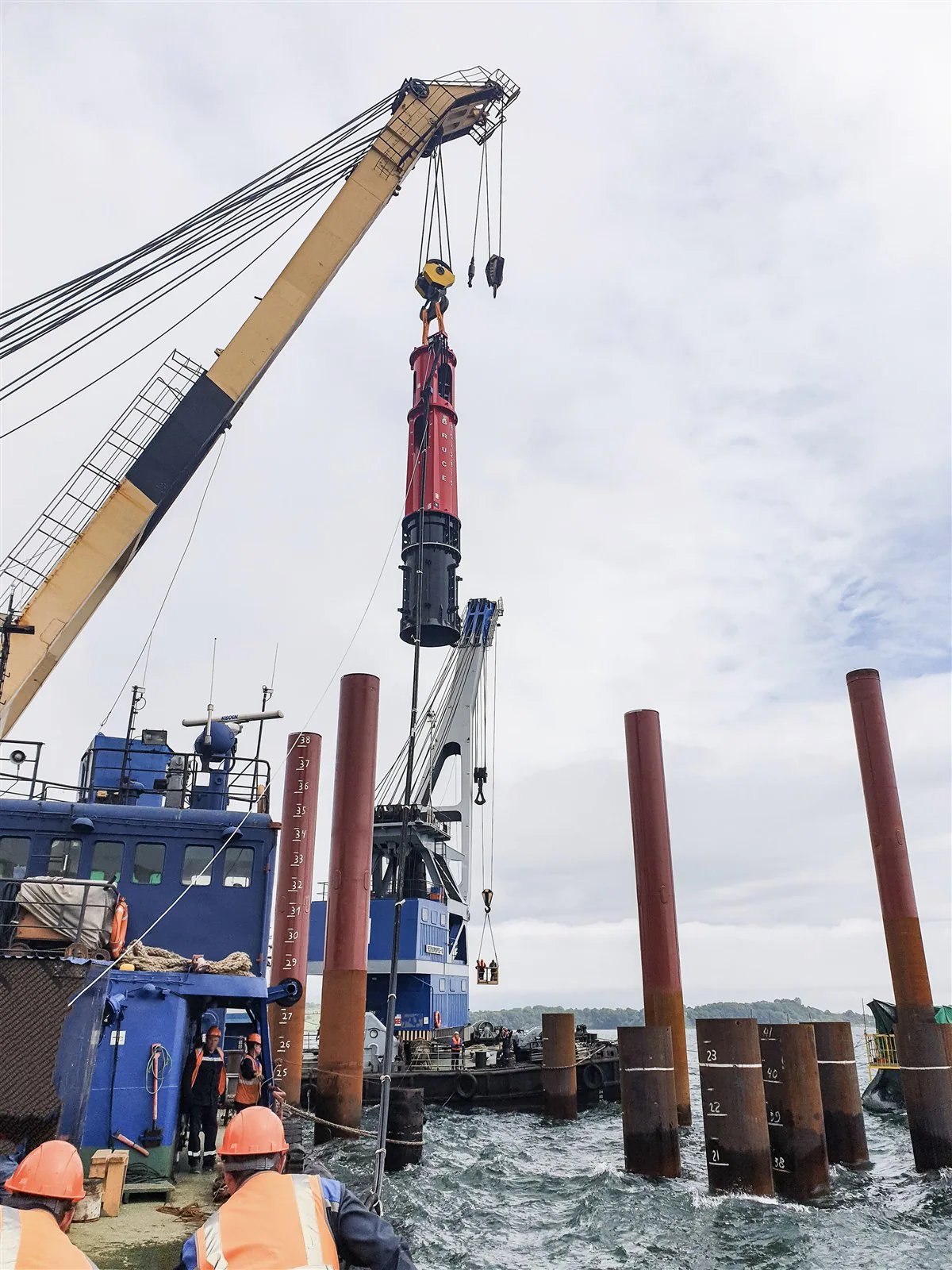
BRUCE hydraulic impact hammer suspended above a vessel work area beside tubular piles. The photograph shows equipment context, not an approved lift, active driving record, or measured project result.
Planning checks
Review the complete marine operation
These checks organize the project review. They do not provide universal hammer settings, lifting capacities, weather limits, or environmental thresholds.
Technical data table: Planning item, Information to check, Required decision
Planning item
Information to check
Required decision
Pile and ground
Pile purpose, geometry, material, seabed profile, and obstructions.
Define the installation and acceptance requirements before selecting a hammer.
Vessel and crane
Actual configuration, stability, positioning, deck loads, and motion effects.
Use an approved marine lift plan and configuration-specific limits.
Hammer and interfaces
Cap, cushion or clamp, guides, lifting arrangement, power pack, and hoses.
Check fit and the manufacturer’s permitted duty; do not infer underwater capability.
Environment and weather
Water conditions, sound receptors, sediment, wildlife, and permit conditions.
Set monitoring, operating limits, stop actions, and restart authority.
Records and completion
Installation logs, survey, required tests, damage, and any removal records.
The responsible project team assesses acceptance against the design and specification.
Technical basis and limits
FHWA GEC-12, Volume II addresses driven-pile installation, records, and testing. Its guidance does not replace the project’s marine-operation design or acceptance specification.
OSHA 1926.1437 sets U.S. requirements for covered floating cranes and land cranes on barges, including water-use ratings and environmental loads. Fully jacked barges are excluded from that section. Apply the regulations and equipment procedures governing the actual installation.
NOAA’s 2024 acoustic guidance addresses marine-mammal auditory injury and temporary threshold shift. It does not establish one permit or cover all receptors. Washington’s marine piling rules provide jurisdiction-specific removal and environmental examples.
Waterfront projects may include berths, bridge works, temporary cofferdams, and retaining walls. State each pile’s structural or temporary role, section, length, material, installation tolerance, and required final condition. Sheet piles, tubular piles, H-piles, concrete piles, and casing need different interfaces and checks. This guide does not establish that a particular hammer can operate underwater or that one method suits all marine foundations.
●Investigate the seabed and water conditions
Use bathymetric surveys, borings or cone penetration tests, and obstruction records to assess the pile line. Identify variable layers, rock, existing foundations, sediment, and possible scour. The team must also assess water depth, tides, currents, waves, wind, and visibility for handling and positioning. Set operating and suspension limits for the actual vessel, crane, guides, and task; a photograph cannot establish those limits.
●Engineer the vessel and lifting arrangement
Check vessel stability, deck loading, positioning or mooring, access, and recovery with the planned lifting sequence. The lift assessment must include the pile and hammer assemblies, rigging, operating radius, hook height, motion effects, and landing areas. Use manufacturer-approved marine configurations and limits. An onshore load chart does not establish a floating crane’s capacity. Guides and templates need their own geometry, loads, clearances, and survey control.
●Separate installation from capacity verification
Impact hammers install piles through repeated blows. Engineers assess driveability, the hammer-to-pile interface, and pile stresses before defining operating and stopping criteria. Record the hammer settings and penetration with blow counts. These records require engineering interpretation; blow count or final set alone does not prove load-bearing capacity. The project specification defines any restrike, instrumented dynamic testing and analysis, or static load testing needed for acceptance.
●Review vibratory and combined methods
Vibratory hammers can install or extract compatible piles where the ground response and site restrictions permit. Check clamp fit, pile condition, hydraulic supply, lifting duty, and the effect on nearby receptors. A vibratory stage does not establish service capacity from penetration rate alone. A combined vibratory and impact sequence needs defined changeover conditions and compatible interfaces; impact finishing is not a universal requirement for every marine pile.
●Approve installation aids before changing the method
Predrilling, jetting, excavation, or another installation aid can change ground support, pile resistance, and sediment disturbance. Obtain the designer’s and permitting authority’s approvals where required before using or changing an aid. A pile that stops moving does not authorize more crane pull, larger hammer output, or an improvised method change. Follow the defined stop, investigation, correction, and restart process.
●Set monitoring and stop actions
Define actions for loss of alignment, abnormal penetration, pile damage, clamp slip, equipment faults, excessive vessel movement, and environmental triggers. Assign the person who can stop work and the authority for restart. Correlate observations and instrument readings with the pile identifier, time, operating settings, water conditions, and activity. Specify inspection or recovery procedures before an abnormal event occurs.
●Plan removal as a separate operation
Before removing temporary piles, obtain release from the responsible designer and assess pile condition, embedment, breakout demand, and approved equipment duty. An ordinary crane chart does not authorize pulling a stuck pile. Define handling, sudden-release controls, any approved cutting or residual element, and the required seabed survey. Backfill or grout, where specified, treats the ground void; it does not guarantee settlement control or successful extraction.
●Environmental controls
Impact and vibratory operations can both generate underwater sound. Assess underwater sound, airborne noise, sediment disturbance, spills, debris, and protected species under the applicable permits and local rules. Underwater and airborne sound use different assessment methods and cannot share one generic limit.
A project may require observers, work windows, soft start, sound attenuation, or monitoring. Select these controls for the source, water conditions, and receptors; a bubble curtain or soft start does not by itself establish compliance.
●Monitoring, QA and acceptance records
Keep pile drawings, installation logs, equipment settings, penetration and survey records, interruptions, damage reports, and required test results under the same pile identifier. Link environmental readings to the corresponding work activity. The responsible engineer evaluates the specified records and tests against the design and acceptance criteria. Equipment selection, photographs, and a single field reading do not replace that assessment.
●Post-removal seabed and recovered pile checks
Record any residual pile’s coordinates and cut elevation, recovered debris, ground treatment, and disposal route. Confirm the required as-left condition by the specified survey and inspection. Reuse of recovered piles requires a material- and duty-specific engineering assessment, including condition checks and any specified testing. Recovery alone does not establish suitability for another structural role.
●Where BRUCE equipment fits
BRUCE can review SGH impact or SGV vibratory equipment after the project defines the pile, method, and site limits. Confirm the cap, cushion or clamp, hydraulic supply, hoses, lifting arrangement, and documentation for the chosen configuration. Marine surroundings do not establish that a hammer has an underwater operating rating. The project team remains responsible for the foundation design, marine operation, lifting plan, environmental requirements, and acceptance.
QDoes marine work require one particular hammer type?
No. The project team selects impact, vibratory, static, or another approved method from the pile, ground, access, environmental limits, and acceptance requirements. Marine surroundings alone do not determine a hammer model.
QDoes a waterfront photograph prove underwater capability?
No. Confirm the selected model and configuration’s permitted operating depth and conditions with the manufacturer. A suspended hammer beside water is not evidence of an underwater rating.
QDoes final set prove marine pile capacity?
Final set and blow counts require engineering interpretation with the hammer state, pile, soil, and project specification. The responsible engineer defines any analysis, restrike, or load testing needed for acceptance.
QCan one weather or sound limit apply to all marine piling?
No. Vessel and crane configurations, task, site conditions, receptors, and permit requirements differ. Define the applicable limits, monitoring, stop actions, and authority to restart for the actual operation.
Discuss Your Marine Piling Equipment
Send a pile drawing, site photo, and the ground or water information you have. BRUCE can review the applicable hammer and support package with your project team.